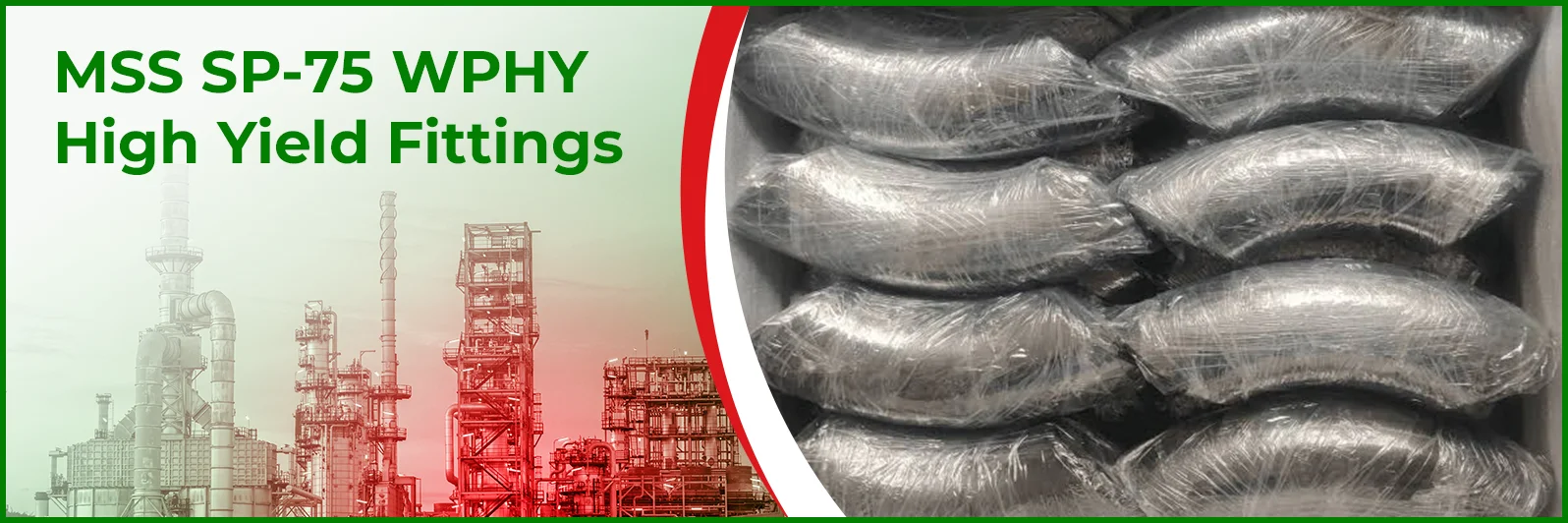
An MSS SP-75 elbow in NPS 24 is almost always made from plate, rolled and welded to shape, which puts a longitudinal weld inside the pressure boundary of the fitting itself. That weld is part of the component, not an attachment, and the pipeline's non-destructive testing requirements have to reach it. ASTM A234 buyers are used to thinking about the girth weld; on pipeline fittings there is a second weld to account for. MSS SP-75 WPHY fittings go onto gas and crude trunk lines across Oman and the GCC. The wider range is on the high yield pipeline fittings and flanges hub.
How SP-75 Differs From A234
| Item | ASTM A234 | MSS SP-75 |
|---|---|---|
|
Written for |
General process and utility piping |
Pipeline service specifically |
|
Grades |
WPB, WPC, alloy and stainless grades |
WPHY 42 through WPHY 70, matched to API 5L X grades |
|
Strength basis |
A tensile range with a yield minimum |
Minimum yield in ksi, matching the line pipe grade |
|
Production route |
Seamless, welded pipe or plate |
Commonly plate or pipe of the matching grade, welded to shape in larger sizes |
|
Weld examination |
Radiography for WP class fittings |
Set by the standard, with the pipeline specification normally adding to it |
|
Typical application |
Inside the fence |
Along the route |
Three points for the enquiry:
- State the NDT requirement for the fitting's own weld, not just for the girth weld, because the pipeline specification usually goes beyond what the standard requires.
- Confirm the production route where your piping or pipeline class restricts welded construction.
- Check the grade against the line pipe, since the whole point of the standard is that the fitting matches the pipe it joins.
Transitions and Unequal Walls
A pipeline rarely runs at one wall for its whole length. Heavier wall is used at crossings, at valve stations and wherever the design calls for it, and where two walls meet the inside has to be tapered rather than stepped, because a step concentrates stress and obstructs pigging. Transition pieces and taper bored ends are ordinary items on a pipeline order, and they need both walls stated on the enquiry rather than one.
Sour Service
Under NACE MR0175 / ISO 15156 Part 2, WPHY fittings in sour service need a hardness limit of 22 HRC with testing on the finished fitting, controlled chemistry, and an accepted heat treatment condition. Where the fitting carries its own weld, that weld and its heat affected zone must meet the hardness limit too, and post-weld heat treatment is normally required. HIC testing to NACE TM0284 on the source material is commonly added.
None of this comes as standard. API 5L PSL2 sour line pipe arrives qualified; SP-75 fittings do not unless the order says so. State the sour requirements in the RFQ and the testing scope is confirmed at quotation.
Pricing MSS SP-75 WPHY High Yield Fittings
- Raw material cost for the grade, including any alloy surcharge
- Item type, size, class and facing
- Wall or bore to match the connecting pipe
- Heat treatment condition and any supplementary tests
- Quantity and whether the item is a standard pattern or a special
- Certification (EN 10204 3.1 or 3.2) and inspection
- Incoterm and destination port
Quotations are available in USD, OMR, AED, SAR, QAR, KWD and BHD, on EXW, FOB, CFR or CIF terms.
What to send for a quotation: item type, material grade and standard, size, pressure class, facing, schedule or wall, quantity, testing, certification, inspection, destination port and required date.
Mill Certificates and Verification
EN 10204 3.1 certificates are supplied as standard, with EN 10204 3.2 certificates on request. Inspection by the buyer's nominated third-party agency can be arranged; state your requirement in the RFQ. The paperwork should record the governing standard and grade, heat number, heat treatment, the grade, and the NDT carried out on the fitting's own weld and tensile results, and should be traceable item by item to the stamping. Specify PMI where more than one grade passes through the same yard. See the MTC and EN 10204 certification guide.
Packing and Storage Before Installation
Lead time is confirmed at quotation. Machined faces, grooves and bevels are protected for sea freight and for storage in Gulf conditions: high ambient heat, humidity, blown sand and coastal chlorides all act on exposed metal. Keep stainless, duplex and nickel items physically separated from carbon steel handling equipment, because embedded iron particles rust and can start pitting on an otherwise sound surface.
Related Pipeline Products
- High yield pipeline fittings and flanges
- ASTM A694 F65 high yield flanges
- API 5L line pipe
- API 5L sour service line pipe
- Buttweld fittings
MSS SP-75 WPHY Fittings FAQ
Why does an SP-75 fitting have its own weld?
Larger pipeline fittings are commonly made from plate or pipe rolled and welded to shape, so a longitudinal weld sits inside the fitting's pressure boundary and the NDT requirement has to reach it.
How do WPHY grades match line pipe?
The grade number is minimum yield in ksi, so WPHY 65 matches API 5L X65 at 448 MPa, and so on through the range from WPHY 42 to WPHY 70.
Can A234 WPB fittings be used on a high yield line?
Not as an equivalent. WPB has 240 MPa minimum yield against 448 MPa for X65, so either the wall increases to compensate or the line is derated at that point.
What happens where two pipeline walls meet?
The inside is tapered rather than stepped, because a step concentrates stress and obstructs pigging. Give both walls on the enquiry so the transition can be made correctly.
Are SP-75 fittings supplied sour qualified?
No. Unlike API 5L PSL2 sour line pipe, the sour requirements on SP-75 fittings are supplementary and have to be stated on the order.
What should I send for a quotation?
Send the fitting type, grade, NPS, wall in millimetres, quantity, NDT scope, sour and impact requirements, certification, inspection and destination port.
Request a Quote for MSS SP-75 WPHY High Yield Fittings
Send the fitting type, grade, size and wall in millimetres, with the NDT scope for the fitting's own weld and the sour requirements. Where walls change along the line, give both walls so transitions are quoted as transitions.