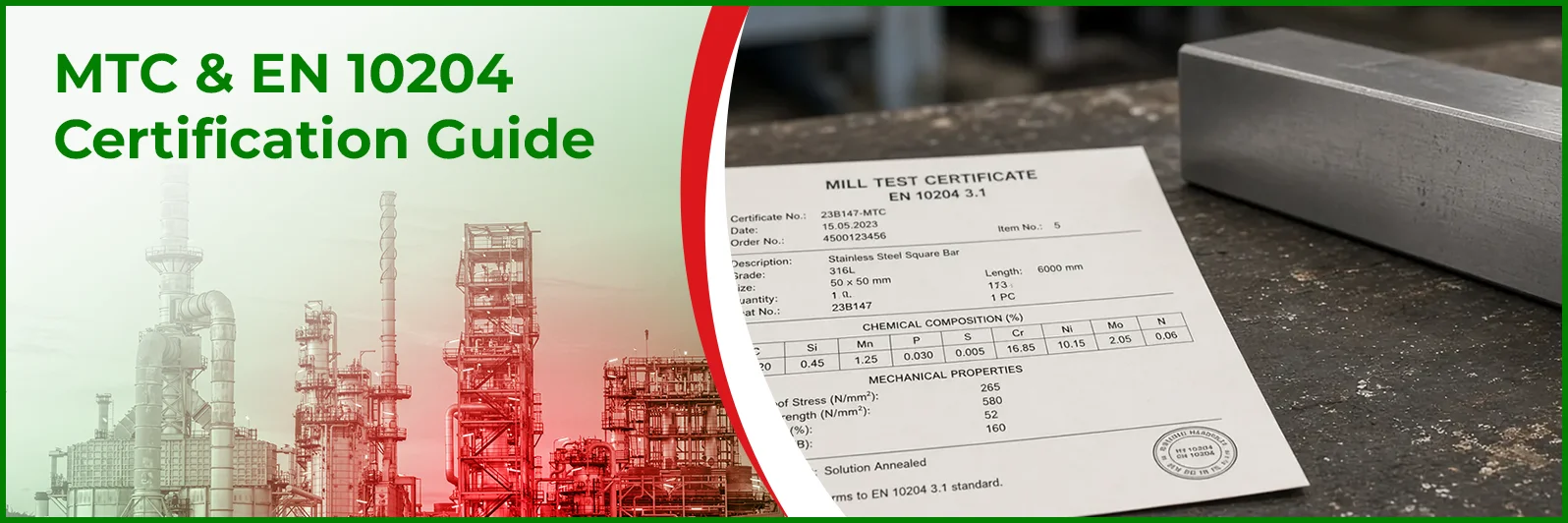
The moment one examines the EN 10204 specification, there is a tendency to interpret the types as what they represent regarding the levels of quality. For example, many buyers consider that obtaining a 3.2 certificate actually means that there is a greater amount of testing involved than obtaining a 3.1 certificate. This is, however, not the case. The difference is who validates the document: a 3.1 is certified by the manufacturer's own inspection department, independent of the production department, while a 3.2 is countersigned by an independent inspector or the purchaser's representative. The tests can be identical. What changes is the witness, and that is why a 3.2 cannot be created after the fact. This MTC and EN 10204 certification guide explains the practical consequences for material supplied acrosspipes and tubes andpipe fittings and flanges.
The Document Types
|
Type |
What it is |
Who issues or validates it |
|---|---|---|
|
2.1 |
Declaration of compliance with the order |
The manufacturer, with no test results |
|
2.2 |
Test report |
The manufacturer, with results from non-specific inspection |
|
3.1 |
Inspection certificate |
The manufacturer's inspection department, independent of production, with results from specific inspection on the material supplied |
|
3.2 |
Inspection certificate |
As 3.1, but also validated by an independent inspector or the purchaser's representative |
Two distinctions carry most of the practical weight:
Specific against non-specific inspection. A 2.2 reports tests that were not necessarily carried out on the material you received. A 3.1 reports tests on that material. That difference is larger than the one between 3.1 and 3.2.
Who signs. 3.1 and 3.2 differ on the witness. Same tests, different validation.
Certification: Buyer Questions
What is the difference between EN 10204 3.1 and 3.2?
Who validates the certificate. A 3.1 is certified by the manufacturer's inspection department independent of production; a 3.2 is also validated by an independent inspector or the purchaser's representative. The tests can be identical.
Can a 3.1 be upgraded to a 3.2 after the material is made?
No. A 3.2 requires third party witnessing of the testing, so it has to be arranged before the tests happen, and re-testing finished material does not reconstruct it.
What is the difference between 2.2 and 3.1?
A 2.2 reports non-specific inspection, so the tests were not necessarily carried out on the material supplied. A 3.1 reports specific inspection on that material.
What proves low temperature capability?
Only the impact test report with its test temperature. Chemistry does not show it and positive material identification cannot find it, because A106 Gr B and A333 Gr 6 are close in chemistry.
How is traceability kept when material is cut?
By transfer marking recorded at the time of the cut, so the piece carries its identification across the cut rather than losing it.
Why does the standard edition matter on a certificate?
Standards are revised and projects are qualified against a stated edition, so material certified to a different edition creates a documentation gap at handover.
Applying This to an Enquiry
State the EN 10204 type in the enquiry, and for 3.2 name the inspection agency and the scope. Certification level affects lead time and cost, and a 3.2 asked for after production cannot be supplied at any price.
Quotations are available in USD, OMR, AED, SAR, QAR, KWD and BHD, on EXW, FOB, CFR or CIF terms, with EN 10204 3.1 certificates as standard and 3.2 on request. Lead time is confirmed at quotation.