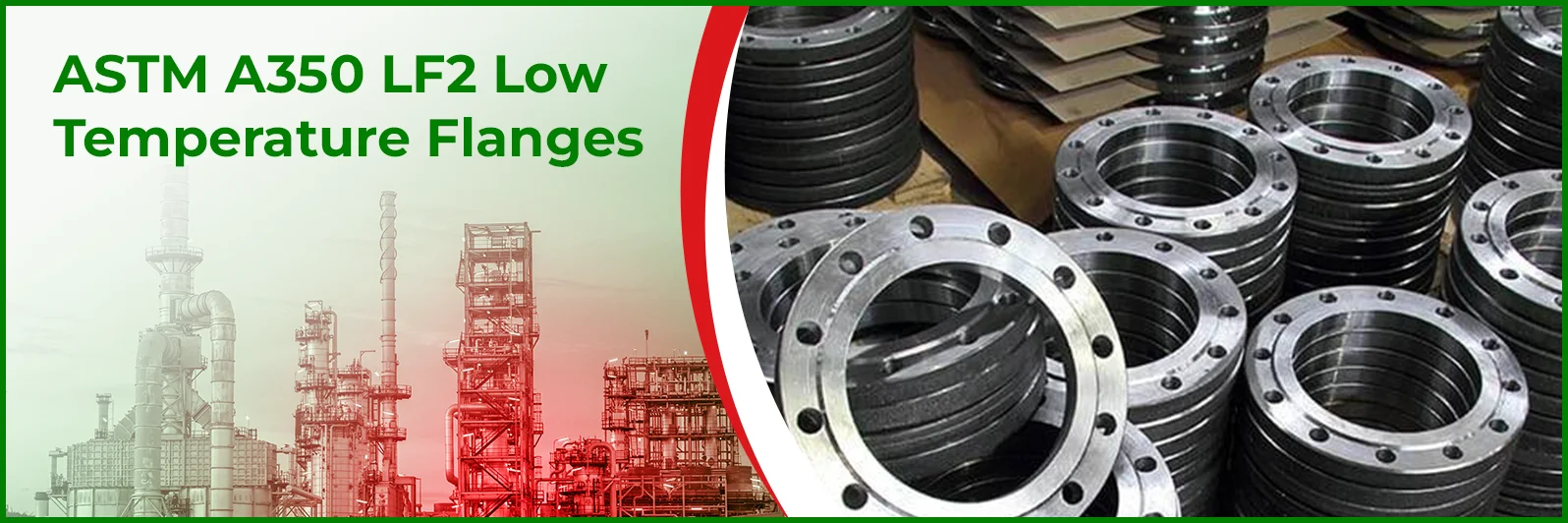
Chemistry will not tell you whether a forging is fit for low temperature service, because LF2 and ordinary A105 are close enough in composition that an analysis alone cannot separate them. The Charpy impact report is what separates them. Three specimens are tested at minus 46 degrees C and the absorbed energy is recorded. ASTM A350 LF2 flanges go into LNG trains, gas processing plants and depressurising systems across Oman, wherever a line can chill below the limit for A105. The wider range sits on the low temperature fittings and flanges hub.
Why Low Temperature Is a Test Result
As carbon steel cools off, it does not become weaker. It becomes more brittle, but this occurs in range of temperatures rather than gradually. Thus, steel that behaves excellently at room temperature may get break easily at 50-60 degrees lower. This transitional temperature depends on the grain size, the method of deoxidization and the type of heat treatment, which are not revealed by the analysis of the chemical composition.
ASTM A350 handles this by making impact testing mandatory. LF2 is tested at minus 46 degrees C, which is why the grade appears on:
- LNG plant piping and loading systems
- Gas processing, where Joule-Thomson cooling across a valve drops line temperature sharply
- Depressurising and blowdown systems, where a line that normally runs warm chills on an emergency release
- Refrigeration and ethylene service
The matching pipe grade is ASTM A333 Grade 6, and the matching buttweld fitting grade is ASTM A420 WPL6.
Chemical Composition
| Element | A350 LF2 (%) |
|---|---|
Carbon | 0.30 max |
Manganese | 0.60 to 1.35 |
Phosphorus | 0.035 max |
Sulphur | 0.040 max |
Silicon | 0.15 to 0.30 |
Copper | 0.40 max |
Nickel | 0.40 max |
Chromium | 0.30 max |
Molybdenum | 0.12 max |
Vanadium | 0.08 max |
The silicon range is a fully killed practice requirement, which is part of how the grade achieves its toughness. The standard also limits the total of the residual elements and sets a carbon equivalent limit.
Sour Service
Low temperature and sour service often arrive together on Omani gas projects, since the same plant handles both. Under NACE MR0175 / ISO 15156 Part 2, LF2 must meet the 22 HRC hardness limit with controlled chemistry and an accepted heat treatment condition. Its 197 HB maximum already sits below that limit. Where both requirements apply, the order needs to state the impact test temperature and the sour requirement together, because a forging supplied to one is not automatically supplied to the other. HIC testing to NACE TM0284 on the source material is commonly added.
What to Check on the Certificate
- The impact test temperature, which must be minus 46 degrees C or the lower figure specified
- The three individual Charpy values and their average, not just a pass statement
- The class, 1 or 2, and the heat treatment condition that supports it
- The heat number, matched to the stamping on the flange itself
- Hardness results where sour service applies
ASTM A350 LF2 Low Temperature Flanges: Price Factors
Each enquiry is priced on its own, because grade, class and testing scope move the figure more than quantity does. What counts:
- Grade and the alloying elements it carries
- Size, pressure class, facing and bore
- Schedule or wall the item is made to
- Production route, forged or formed from pipe or plate
- Supplementary testing and inspection scope
- Order quantity and availability
- Certificate level and witness requirements
- Delivery terms and port of discharge
Quotations are available in USD, OMR, AED, SAR, QAR, KWD and BHD, on EXW, FOB, CFR or CIF terms.
What to send for a quotation:
item type, material grade and standard, size, pressure class, facing, schedule or wall, quantity, testing, certification, inspection, destination port and required date.
Certification, Traceability and PMI
Material comes with EN 10204 3.1 certificates as standard, and EN 10204 3.2 certificates on request. Inspection by the buyer's nominated third-party agency can be arranged; state your requirement in the RFQ. Check that the heat number on the certificate matches the marking on the item itself, and that the heat treatment condition is stated, the Charpy impact results and the test temperature they were taken at. Positive material identification confirms the grade before anything is welded in. See the MTC and EN 10204 certification guide.
Delivery and Handling
Lead time is confirmed at quotation. Fittings ship bundled or crated with bevel protection; flanges ship with face and ring groove protection, since a scored face leaks whatever the gasket. In coastal Oman, salt deposits build up on anything left in the open, so a rinse and a dry before fitting up is worth the time.
Related Low Temperature Products
- Low temperature fittings and flanges
- ASTM A420 WPL6 fittings
- ASTM A350 LF2 forged fittings
- ASTM A333 Grade 6 pipes
- ASTM A105 carbon steel flanges
ASTM A350 LF2 Flanges FAQ
At what temperature is A350 LF2 impact tested?
Minus 46 degrees C, using a Charpy V-notch test on a set of three specimens. A lower test temperature must be specified on the order.
Can I tell LF2 from A105 by chemistry?
No. The compositions are close enough that an analysis alone will not separate them. The impact test report is what identifies the grade.
What is the difference between LF2 Class 1 and Class 2?
They are different heat treatment conditions. Class 1 is normalised, or normalised and tempered; Class 2 carries a higher tempering requirement for more consistent toughness. The class should be stated on the order.
Which pipe and fittings match LF2 flanges?
ASTM A333 Grade 6 pipe and ASTM A420 WPL6 buttweld fittings, both impact tested at the same temperature.
Is LF2 suitable for sour service as well?
It can be. Under NACE MR0175 / ISO 15156 Part 2 it must meet the 22 HRC limit, which its 197 HB maximum covers, but the sour requirement has to be stated separately from the impact requirement.
What should I send for a quotation?
Send the pattern, NPS, pressure class, facing, bore schedule, class 1 or 2, impact test temperature, quantity, certification, inspection and destination port.
Request a Quote for ASTM A350 LF2 Low Temperature Flanges
Send the pattern, size, class, facing and bore schedule, along with the impact test temperature the design calls for. Where the order needs both low temperature and sour service, both are confirmed on the offer so the certificate carries each one.