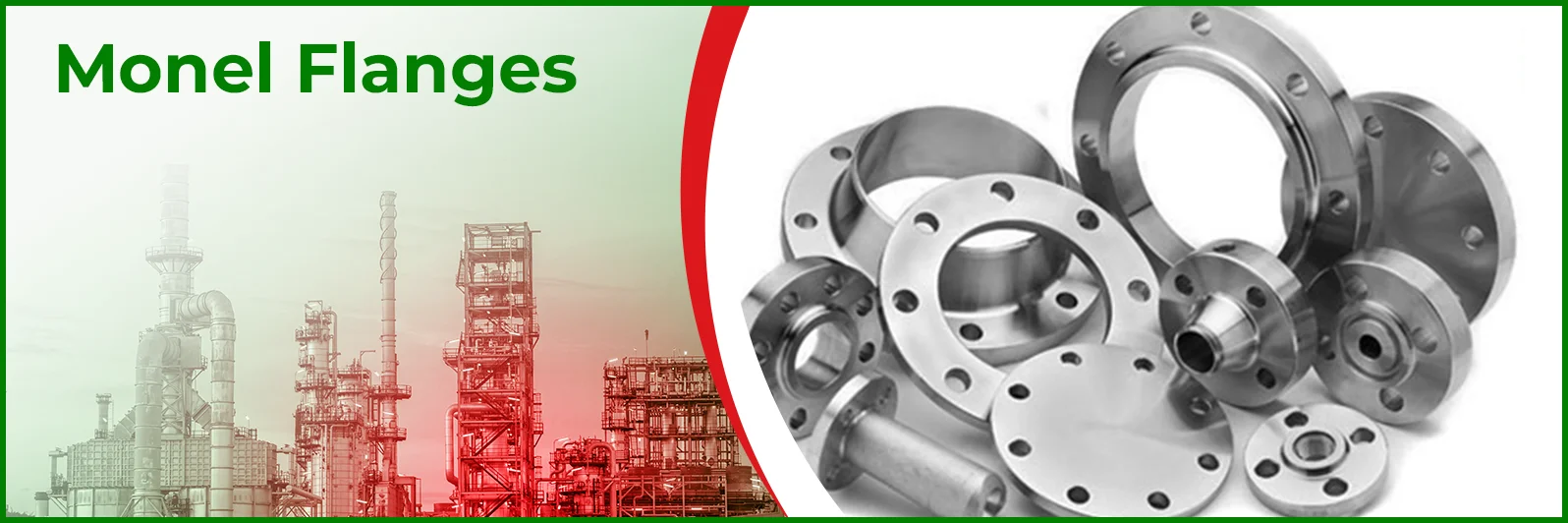
Monel reacts in seawater contrary to most metal alloys. It works in running water, but it runs into mischief in stagnant water. Areas of stagnant seawater are the killers: where stagnant seawater is trapped, the sulfide and deposits will attack the metal, causing pitting to commence in those areas, not in the bore itself. Monel flanges are used extensively in seawater, brine and HF applications in Oman and the GCC. No chromium-bearing alloy does the same job. The range is on the nickel alloy fittings and flanges hub.
What Monel Resists, and What It Does Not
Monel 400 is a nickel-copper alloy with no chromium at all, and that single fact explains both halves of its behaviour.
| Service | Monel 400 |
|---|---|
Flowing seawater | Good resistance, long established in marine piping |
Stagnant or low flow seawater | Vulnerable to pitting and crevice attack, especially where sulphides are present |
Hydrofluoric acid | One of the few materials accepted for this duty |
Reducing acids such as dilute sulphuric and hydrochloric | Good resistance |
Oxidising acids such as nitric | Poor, the lack of chromium leaves nothing to passivate |
Oxidising salts, ferric and cupric chloride | Poor |
Dry chlorine and chlorinated seawater | Poor, the oxidising conditions defeat it |
Three consequences for flanged joints specifically:
- The gasket crevice is the exposure that matters. In seawater service it is the one part of the joint that never sees flow, so gasket choice and joint design carry more weight than they would on a chromium-bearing alloy.
- Lay-up matters. A Monel line left full and idle through a shutdown is in its worst condition. Draining, flushing with clean water, or keeping flow on are the usual answers, and the piping engineer should decide which.
- Chlorination is a problem, not a solution. Seawater systems dosed with hypochlorite to control fouling push conditions towards the oxidising side, where Monel is weak. If the system is chlorinated, say so at enquiry, because the alloy choice may need to change.
Where Monel Flanges Are Used in the GCC
- Seawater lift, cooling and ballast systems on offshore and marine installations
- Brine handling in desalination and water treatment plants
- Hydrofluoric acid alkylation units in refinery and petrochemical service
- Heat exchanger piping where seawater is the cooling medium
- Crude distillation overhead systems where hydrochloric acid forms
Bolting, Galvanic Pairs and PMI
Monel is noble relative to carbon steel and to most stainless steels, so in a galvanic couple it is the other metal that corrodes. That sounds convenient until the other metal is the bolting. Monel or Monel K-500 studs keep the joint consistent; carbon steel studs on a Monel flange in a marine atmosphere will be the sacrificial member and will lose section before the flange shows anything.
Positive material identification on receipt belongs in the order, since Monel is visually indistinguishable from several other nickel alloys once marking wears, and installing the wrong one removes the resistance the system was designed around.
Sour Service
NACE MR0175 / ISO 15156 Part 3 lists the nickel alloys acceptable for sour service with environmental limits on hydrogen sulphide partial pressure, chloride content, temperature and elemental sulphur, and with hardness limits that depend on the alloy and its condition. Sulphides are also the specific contaminant that drives Monel pitting in stagnant seawater, so a service that is both sour and marine needs the two effects assessed together rather than separately. Send the full service envelope with the enquiry.
What Moves the Price of Monel Flanges
- Material grade and alloy content, which carry market surcharges
- Type, size, pressure class and facing
- Matching pipe schedule or fitting wall
- Forged or wrought, and seamless or welded construction
- Testing: hardness, impact testing, NDT, PMI and ferrite checks where they apply
- Quantity against mill or forge minimums
- Certification level (EN 10204 3.1 or 3.2) and third-party inspection
- Incoterm and destination port
Quotations are available in USD, OMR, AED, SAR, QAR, KWD and BHD, on EXW, FOB, CFR or CIF terms.
What to send for a quotation: item type, material grade and standard, size, pressure class, facing, schedule or wall, quantity, testing, certification, inspection, destination port and required date.
Monel Flanges: Certificates and Inspection
Supplied with EN 10204 3.1 certificates as standard, and EN 10204 3.2 certificates on request. Inspection by the buyer's nominated third-party agency can be arranged; state your requirement in the RFQ. The certificate should carry the material standard and grade, heat number, heat treatment condition and mechanical results, and the annealed condition. PMI on receipt is worth specifying wherever grades share a store or a fabrication shop, since a stencil is only paint. See the MTC and EN 10204 certification guide.
Packing, Delivery and Gulf Site Storage
Lead time is confirmed at quotation. Items are packed in crates or bundles, with bevels and machined faces protected. On Gulf laydown yards the two things that cause rework are a damaged sealing face and surface contamination, so keep face protectors on until assembly and store alloy items clear of carbon steel racking, slings and grinding dust.
Related Nickel Alloy Products
- Nickel alloy fittings and flanges
- Inconel flanges
- Hastelloy flanges
- Monel 400 pipes and tubes
- Copper nickel 90/10 pipes and tubes
Monel Flanges FAQ
Why does stagnant seawater matter more than flowing seawater for Monel?
Monel resists moving seawater well, but in still water sulphides and deposits accumulate against the metal and pitting starts. The gasket crevice on a flange is the part that never sees flow.
Can Monel be used in chlorinated seawater?
Not reliably. Hypochlorite dosing pushes conditions towards the oxidising side, where an alloy with no chromium has nothing to passivate with. State whether the system is chlorinated at enquiry.
What bolting should be used with Monel flanges?
Monel or Monel K-500 studs. Monel is noble relative to carbon steel, so carbon steel studs become the sacrificial member in a marine atmosphere and lose section.
Why is Monel used for hydrofluoric acid?
It is one of the few materials accepted for that duty, because its resistance comes from nickel and copper rather than from a chromium oxide film that hydrofluoric acid would attack.
Are Monel flanges rated the same as carbon steel?
No. ASME B16.5 Annex A assigns nickel alloys to their own material groups, so the carbon steel rating table does not apply.
What should I send for a quotation?
Send the pattern, NPS, pressure class, facing, bore schedule, quantity, service conditions including whether the system is chlorinated, certification, inspection and destination port.
Request a Quote for Monel Flanges
Send the pattern, size, class, facing and bore schedule with the service conditions, including whether the seawater is chlorinated and whether the line sits idle between runs. Both change whether Monel is the right alloy for the joint.