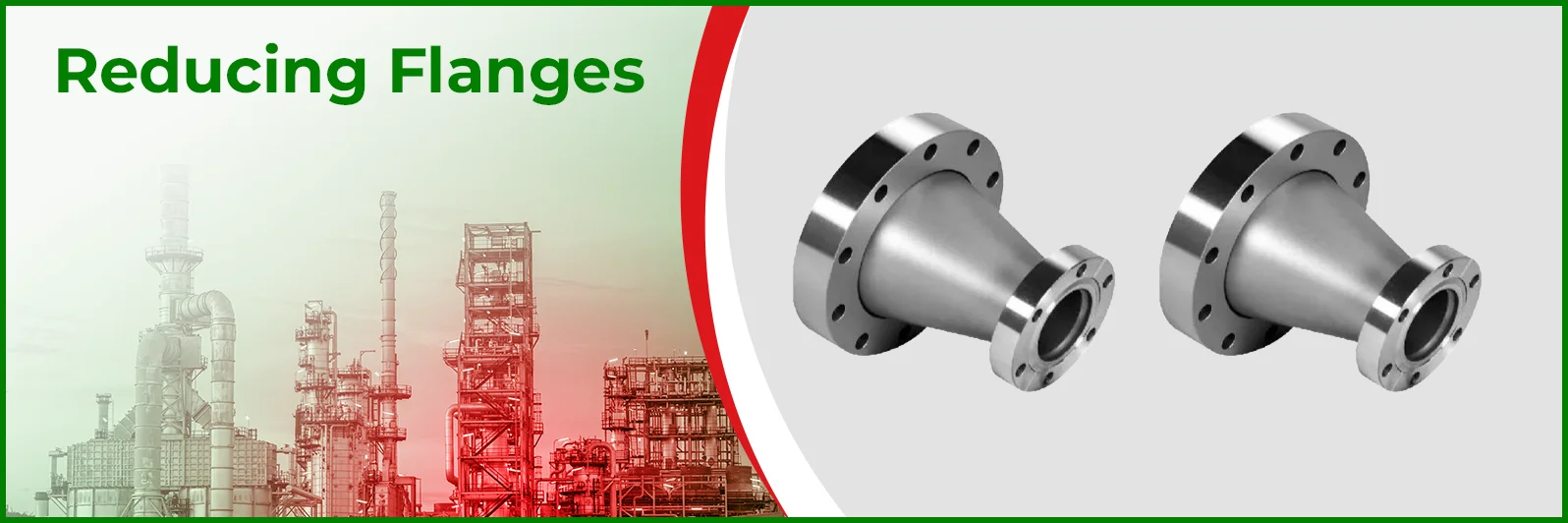
A reducing flange carries the full outside diameter, bolt circle and thickness of the larger size while being bored for a smaller pipe, so one item replaces a reducer, a flange and the weld between them. That is the saving. What it also does is change diameter abruptly at the flange face rather than over the length of a reducer, which disturbs the flow profile, so a reducing flange is the wrong choice upstream of anything that measures. Reducing flanges go onto process and utility piping across Oman and the GCC. The wider range is on the specialty flanges hub.
What You Gain and What You Give Up
| Gained | Given up |
|---|---|
One item in place of a reducer plus a flange | A smooth transition. The diameter change happens at the face |
One fewer weld to make, inspect and heat treat | Predictable flow profile downstream |
Shorter overall length where space is tight | Suitability upstream of orifice plates, flow meters and control valves |
Lower fabrication cost and time | Some fatigue performance, because the section change is abrupt |
The rule that follows is simple enough to apply at the drawing stage: a reducing flange is appropriate where the line simply changes size and the flow does not have to be well behaved afterwards. It is not appropriate on the upstream side of a measurement point, where orifice flanges need a defined straight run and a known bore, and it is usually excluded ahead of control valves and pump suctions.
Where a smooth transition matters, the answer is a concentric or eccentric buttweld reducer with a standard flange behind it.
Patterns
| Pattern | How it works | Note |
|---|---|---|
Reducing weld neck | Larger flange dimensions with a hub bored and bevelled for the smaller pipe | The most common pattern. The hub is sized to the smaller pipe |
Reducing slip-on | Larger flange dimensions with a bore to slide over the smaller pipe | Welded inside and out like any slip-on, with the same restrictions |
Reducing threaded | Larger flange dimensions with a smaller threaded connection | Utility and low pressure service |
Reducing blind | A blind flange with a tapped or bored connection | Sometimes used in place of a reducing flange plus a small nozzle |
On a reducing weld neck flange the hub follows the smaller pipe, so the bore has to be ordered against the smaller pipe's schedule or wall, not the larger size's. That is the detail most often confused on an order, and it produces a flange that cannot be welded to either pipe.
Where Reducing Flanges Are Used
- Pump and compressor connections where the nozzle size differs from the line size
- Vessel and tank nozzles with a line size change at the connection
- Utility headers stepping down to branch lines
- Instrument and sample connections on larger lines
- Retrofit work where a line size change has to fit in an existing space
Sour Service
Under NACE MR0175 / ISO 15156, reducing flanges carry the same obligations as any other pressure component. Carbon and low-alloy steel needs a hardness limit of 22 HRC with an accepted heat treatment condition, and stainless, duplex and nickel alloys fall under Part 3 with environmental limits by alloy. Because more material is removed during machining, the finished section can differ from a standard flange of the same size, which is worth noting where hardness testing is specified on the finished item. State your sour service requirements in the RFQ.
Reducing Flanges: Price Factors
Each enquiry is priced on its own, because grade, class and testing scope move the figure more than quantity does. What counts:
- Grade and the alloying elements it carries
- Size, pressure class, facing and bore
- Schedule or wall the item is made to
- Production route, forged or formed from pipe or plate
- Supplementary testing and inspection scope
- Order quantity and availability
- Certificate level and witness requirements
- Delivery terms and port of discharge
Quotations are available in USD, OMR, AED, SAR, QAR, KWD and BHD, on EXW, FOB, CFR or CIF terms.
What to send for a quotation:
item type, material grade and standard, size, pressure class, facing, schedule or wall, quantity, testing, certification, inspection, destination port and required date.
Certification, Traceability and PMI
Material comes with EN 10204 3.1 certificates as standard, and EN 10204 3.2 certificates on request. Inspection by the buyer's nominated third-party agency can be arranged; state your requirement in the RFQ. Check that the heat number on the certificate matches the marking on the item itself, and that the heat treatment condition is stated, and both sizes recorded, the flange size and the bore size. Positive material identification confirms the grade before anything is welded in. See the MTC and EN 10204 certification guide.
Delivery and Handling
Lead time is confirmed at quotation. Fittings ship bundled or crated with bevel protection; flanges ship with face and ring groove protection, since a scored face leaks whatever the gasket. In coastal Oman, salt deposits build up on anything left in the open, so a rinse and a dry before fitting up is worth the time.
Related Flanges and Fittings
Reducing Flanges: Buyer Questions
When should a reducing flange not be used?
Upstream of orifice plates, flow meters, control valves and pump suctions, because the diameter changes abruptly at the face and disturbs the flow profile.
Which pipe schedule does the bore follow?
The smaller pipe's schedule or wall, since the hub is sized to the pipe being welded to it. Ordering the bore against the larger size produces a flange that fits neither pipe.
How should both sizes be written on an order?
As flange size by bore size, with the convention stated, plus the bore schedule separately. A description such as NPS 8 x 6 is only clear once that convention is agreed.
Is there a limit on how far a reducing flange can reduce?
Yes. The hub has to fit within the flange body with enough material around it, so large reductions are made as a standard flange with a buttweld reducer behind it instead.
What does a reducing flange save?
A reducer, a flange and the weld between them, along with the inspection and any heat treatment that weld would need.
What should I send for a quotation?
Send the flange size, bore size, bore schedule, pressure class, facing, pattern, grade, quantity, certification, inspection and destination port.
Request a Quote for Reducing Flanges
Send both sizes with the bore schedule, the class, facing, pattern and grade. Where a reducing flange is specified upstream of a measurement point, that is raised with the offer, because the item will be correct and the measurement will not.