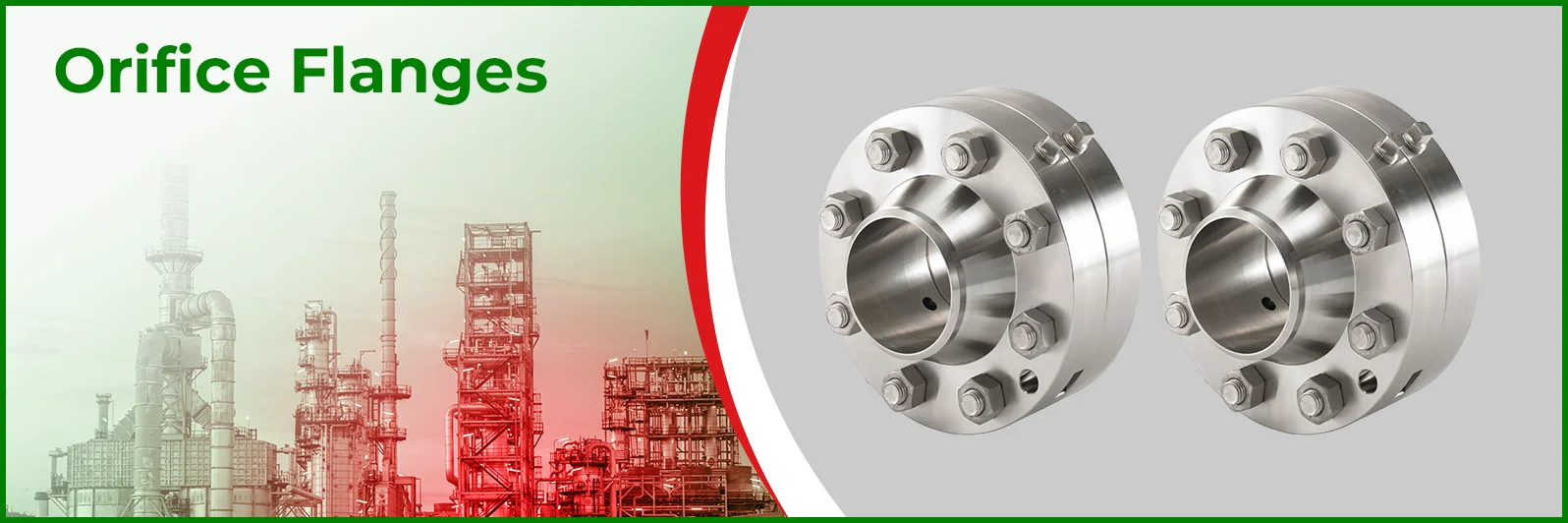
Every other flange on a plant is a pressure boundary. An orifice flange is also a measuring instrument, because the flow calculation takes the internal pipe diameter as an input, and the number used is the bore of the flange the plate sits between. Take that bore from a schedule table instead of a measurement and the meter carries an error nobody can see in the reading. Orifice flanges go onto custody transfer, allocation and process control measurement across Oman and the GCC. The wider range is on the specialty flanges hub.
What the Meter Needs From the Flange
Differential pressure flow measurement works from the pressure drop across a plate with a known bore, in a pipe with a known bore. Both diameters enter the calculation, and an error in either propagates straight into the measured flow.
| Item | Why it matters to the measurement |
|---|---|
Flange bore, measured and recorded | It is the internal pipe diameter in the calculation, not a nominal value from a schedule table |
Bore concentricity with the plate | An offset puts the plate off centre in the flow and distorts the differential |
Tapping position and orientation | Flange taps sit 25.4 mm from each face of the plate. Orientation decides whether the tappings are accessible once installed |
Surface finish and bore smoothness | Roughness and steps upstream of the plate change the velocity profile |
Straight run upstream and downstream | Set by the installation standard rather than by the flange, but the flange pair has to be positioned to suit it |
Two things to put on the enquiry that routine flange orders never carry:
- The measured bore, where the meter calculation or a custody transfer requirement depends on it. State whether a measurement record is required.
- The tapping orientation, since tappings in the wrong plane make the transmitter impossible to pipe up without rework.
What an Orifice Flange Set Includes
| Component | Note |
|---|---|
Two flanges | Supplied as a matched pair, called an orifice flange union |
Pressure tappings | Normally two per flange, threaded, with plugs where unused |
Jack screws | Fitted to spread the flanges so the plate can be changed without dismantling the line |
Bolting | Longer than a standard joint, to span the plate, two gaskets and the jack screw arrangement |
Gaskets | Two, one each side of the plate |
Orifice plate and carrier | Often a separate instrument scope item. State whether it is in your enquiry |
Confirm the plate scope explicitly. A set quoted without the plate and a set quoted with it are different line items, and the plate is usually specified by the instrument engineer rather than the piping engineer.
Patterns, Classes and Standards
| Standard | Scope |
|---|---|
ASME B16.36 | Orifice flanges, dimensions and tappings, Classes 300, 400, 600, 900, 1500 and 2500 |
ASME B16.5 | The parent flange dimensions the orifice flanges follow |
ASME B16.20 | Ring joint gaskets where ring type joint facing is used |
Orifice flanges are made in weld neck, slip-on and threaded patterns, with weld neck the normal choice on process measurement because the bore is machined and the hub transfers load gradually. Facings are raised face or ring type joint; RTJ flanges have their own requirements.
Class 150 is not listed in ASME B16.36. Where a Class 150 measurement point is needed, the usual route is a Class 300 orifice union or a different flow element.
Sizes are supplied to specification. Send the NPS, class, facing, bore schedule or measured bore, pattern, tapping size and orientation.
Where Orifice Flanges Are Used
- Custody transfer and allocation measurement in oil and gas service
- Process control flow measurement in refinery and petrochemical units
- Steam and feedwater measurement on power generation plants
- Utility flows, fuel gas and instrument air metering
Sour Service
Under NACE MR0175 / ISO 15156, orifice flanges carry the same obligations as any other component in the line. Carbon and low-alloy steel needs a hardness limit of 22 HRC with an accepted heat treatment condition; stainless, duplex and nickel alloys fall under Part 3 with environmental limits by alloy. The tappings and plugs are part of the pressure boundary and are covered too, which is the item most often forgotten because it is bought as a small accessory. State your sour service requirements in the RFQ.
What Moves the Price of Orifice Flanges
- Material grade and alloy content, which carry market surcharges
- Type, size, pressure class and facing
- Matching pipe schedule or fitting wall
- Forged or wrought, and seamless or welded construction
- Testing: hardness, impact testing, NDT, PMI and ferrite checks where they apply
- Quantity against mill or forge minimums
- Certification level (EN 10204 3.1 or 3.2) and third-party inspection
- Incoterm and destination port
Quotations are available in USD, OMR, AED, SAR, QAR, KWD and BHD, on EXW, FOB, CFR or CIF terms.
What to send for a quotation:
item type, material grade and standard, size, pressure class, facing, schedule or wall, quantity, testing, certification, inspection, destination port and required date.
Orifice Flanges: Certificates and Inspection
Supplied with EN 10204 3.1 certificates as standard, and EN 10204 3.2 certificates on request. Inspection by the buyer's nominated third-party agency can be arranged; state your requirement in the RFQ. The certificate should carry the material standard and grade, heat number, heat treatment condition and mechanical results, and the measured bore where the meter calculation depends on it. PMI on receipt is worth specifying wherever grades share a store or a fabrication shop, since a stencil is only paint. See the MTC and EN 10204 certification guide.
Packing, Delivery and Gulf Site Storage
Lead time is confirmed at quotation. Items are packed in crates or bundles, with bevels and machined faces protected. On Gulf laydown yards the two things that cause rework are a damaged sealing face and surface contamination, so keep face protectors on until assembly and store alloy items clear of carbon steel racking, slings and grinding dust.
Related Flanges
- Specialty flanges
- Weld neck flanges
- RTJ ring type joint flanges
- Blind flanges
- Pipe fittings and flanges
Orifice Flanges FAQ
Why does the flange bore have to be measured?
Because the internal pipe diameter is an input to the flow calculation. A nominal figure from a schedule table introduces an error that does not show up in the reading.
What does an orifice flange union include?
Two matched flanges with pressure tappings, jack screws to spread them for plate changes, longer bolting to span the plate and two gaskets. The orifice plate itself is often a separate instrument item.
Where are flange tappings located?
Flange taps sit 25.4 mm from each face of the orifice plate. The orientation has to be stated so the transmitter can be piped up without rework.
Are orifice flanges available in Class 150?
ASME B16.36 does not list Class 150. A Class 300 orifice union or a different flow element is the usual route at that pressure.
What are the jack screws for?
They spread the flange pair so the orifice plate can be removed and replaced without dismantling the pipework either side.
What should I send for a quotation?
Send the NPS, pressure class, facing, pattern, bore or bore schedule, tapping size and orientation, whether the plate is in scope, quantity, certification and destination port.
Request a Quote for Orifice Flanges
Send the size, class, facing, pattern and bore, with the tapping orientation and whether the orifice plate is in your scope. Sets quoted without a tapping orientation are queried, because a union installed in the wrong plane has to come out again.