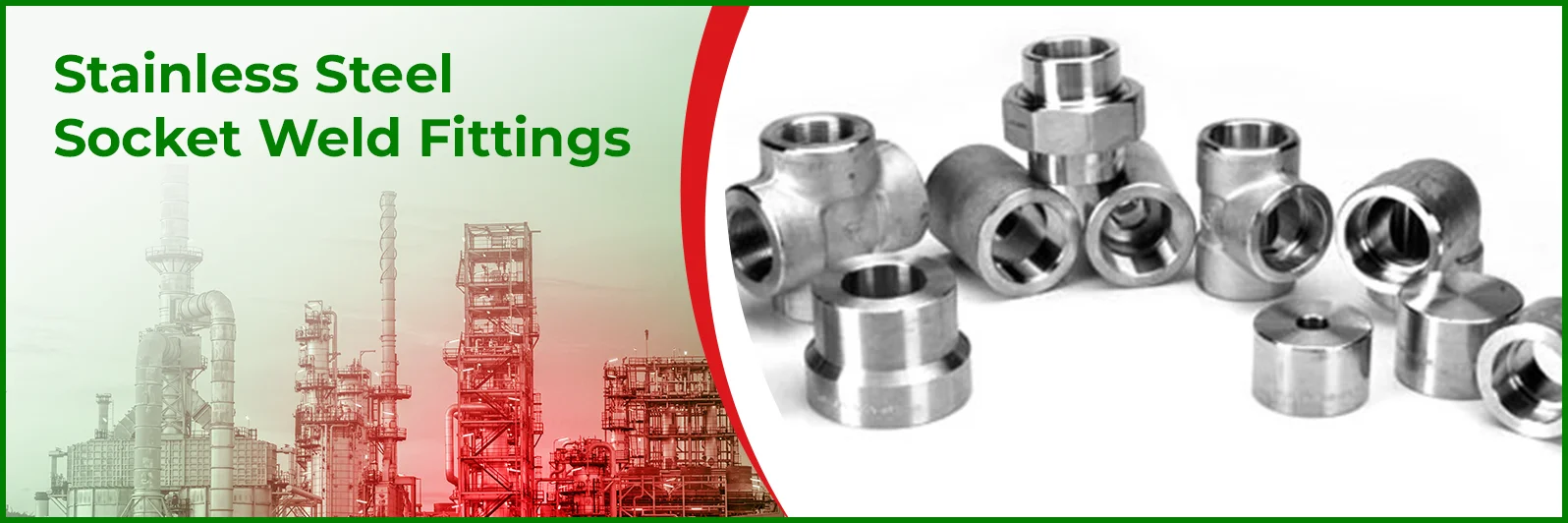
Designate 316 for a small diameter line, and the alloy will withstand the chlorides in the flow. The narrow space found between the pipe and the socket is a different matter. In this cavity, the liquid stagnates, oxygen gets consumed, and chlorides increase to levels that never exist at the open surface. Crevice corrosion begins in this area and goes undetected externally. Stainless steel socket weld fittings still carry instrument, chemical and utility small bore work across Oman and the GCC, within limits worth knowing. The wider range is on the stainless steel fittings and flanges hub.
Why the Crevice Behaves Differently from the Pipe
Austenitic stainless resists corrosion through a passive chromium oxide film that needs oxygen to repair itself. Inside a tight crevice, three things happen in sequence:
- The oxygen in the trapped fluid is used up and cannot be replenished
- The passive film can no longer repair, so metal begins to dissolve
- Chloride migrates in to balance the charge, the local acidity rises, and the attack accelerates
The result is attack inside a joint that looks sound from outside, in a grade that handles the same fluid perfectly well in open pipe. It is the reason many GCC operator specifications exclude socket weld construction from chloride-bearing, sour and other corrosive service regardless of the grade, and route small bore to butt welded joints or to instrumentation tubing with compression fittings instead.
Where socket weld is permitted, the mitigations are practical: keep the service clean and oxygenated, avoid dead legs that let fluid stagnate, step up to 316L or a higher alloy rather than 304L, and favour butt welded joints on anything that will sit idle.
Classes and Matching Pipe Schedule
| Fitting class | Matching pipe schedule |
|---|---|
Class 3000 | Schedule 80 or 80S |
Class 6000 | Schedule 160 |
Class 9000 | Schedule XXS |
Class 3000 covers most stainless small bore work. Note the conflict this creates with ordinary stainless practice: stainless process piping often runs at Schedule 10S or 40S, and no socket weld class pairs with those walls. A line built in 10S with socket weld fittings has a mismatch at every joint. That is one more reason butt welding dominates thin wall stainless.
ASME B16.11 covers NPS 1/8 to 4, with socket weld used mainly up to NPS 2.
Sizes are supplied to specification. Send the fitting type, grade, class, NPS and the pipe schedule.
Installation Rules That Still Apply
The bottoming gap. Insert the pipe until it bottoms, withdraw approximately 1.6 mm, then tack. ASME B31.1 and B31.3 require the clearance, because the fillet weld contracts as it cools and a pipe hard against the shoulder drives that contraction into the root.
Back purging. The root side of a stainless fillet weld oxidises without an argon purge, leaving scale with poor corrosion resistance facing the process. On a socket weld joint that scale sits right at the crevice.
Heat input. Keep it controlled. Excess heat holds the heat affected zone in the sensitising range and undoes the solution annealing the forging was supplied with.
Fillet size. The weld leg is set against the pipe wall by the applicable code, and an undersized fillet is a common inspection rejection.
Sour Service
Under NACE MR0175 / ISO 15156 Part 3, austenitic grades are acceptable within environmental limits on hydrogen sulphide partial pressure, chloride content and temperature, in the solution annealed condition and within a hardness limit. The fillet weld and its heat affected zone must meet the hardness limit too. On sour duty the crevice is the design question rather than the material question, so raise it with the piping engineer before the fittings are ordered. State your requirements in the RFQ.
What Moves the Price of Stainless Steel Socket Weld Fittings
- Material grade and alloy content, which carry market surcharges
- Type, size, pressure class and facing
- Matching pipe schedule or fitting wall
- Forged or wrought, and seamless or welded construction
- Testing: hardness, impact testing, NDT, PMI and ferrite checks where they apply
- Quantity against mill or forge minimums
- Certification level (EN 10204 3.1 or 3.2) and third-party inspection
- Incoterm and destination port
Quotations are available in USD, OMR, AED, SAR, QAR, KWD and BHD, on EXW, FOB, CFR or CIF terms.
What to send for a quotation:
item type, material grade and standard, size, pressure class, facing, schedule or wall, quantity, testing, certification, inspection, destination port and required date.
Stainless Steel Socket Weld Fittings: Certificates and Inspection
Supplied with EN 10204 3.1 certificates as standard, and EN 10204 3.2 certificates on request. Inspection by the buyer's nominated third-party agency can be arranged; state your requirement in the RFQ. The certificate should carry the material standard and grade, heat number, heat treatment condition and mechanical results. PMI on receipt is worth specifying wherever grades share a store or a fabrication shop, since a stencil is only paint. See the MTC and EN 10204 certification guide.
Packing, Delivery and Gulf Site Storage
Lead time is confirmed at quotation. Items are packed in crates or bundles, with bevels and machined faces protected. On Gulf laydown yards the two things that cause rework are a damaged sealing face and surface contamination, so keep face protectors on until assembly and store alloy items clear of carbon steel racking, slings and grinding dust.
Related Products
- Stainless steel buttweld fittings
- Stainless steel forged fittings
- Socket weld fittings
- Socket weld flanges
- Stainless steel instrumentation tubing
Stainless Steel Socket Weld Fittings: Buyer Questions
Why is crevice corrosion a problem on stainless socket welds?
Inside the annular gap the trapped fluid loses oxygen, so the passive film cannot repair, and chloride concentrates locally. The attack happens inside a joint that looks sound from outside.
Which grade should be used for socket weld fittings?
F316L is the usual choice. The low carbon limits sensitisation at the fillet weld and the molybdenum gives the crevice better resistance than F304L.
Which pipe schedule matches Class 3000 socket weld fittings?
Schedule 80 or 80S. Stainless process piping often runs at 10S or 40S, which no socket weld class pairs with, so butt welding is usually preferred on thin wall stainless.
Why is a gap left at the bottom of the socket?
The fillet weld contracts as it cools, and a pipe hard against the socket shoulder drives that contraction into the weld root. ASME B31.1 and B31.3 require approximately 1.6 mm clearance.
Does the root need purging?
Yes. Without an argon purge the root side oxidises and leaves scale with poor corrosion resistance facing the process, right at the crevice.
What should I send for a quotation?
Send the fitting type, grade, class, NPS, pipe schedule, quantity, testing, certification, inspection and destination port.
Request a Quote for Stainless Steel Socket Weld Fittings
Send the fitting type, grade, class and size with quantities, and say what the line carries. Where the service makes the socket crevice a risk, or the class does not pair with the pipe schedule, that is raised before the offer rather than at design review.