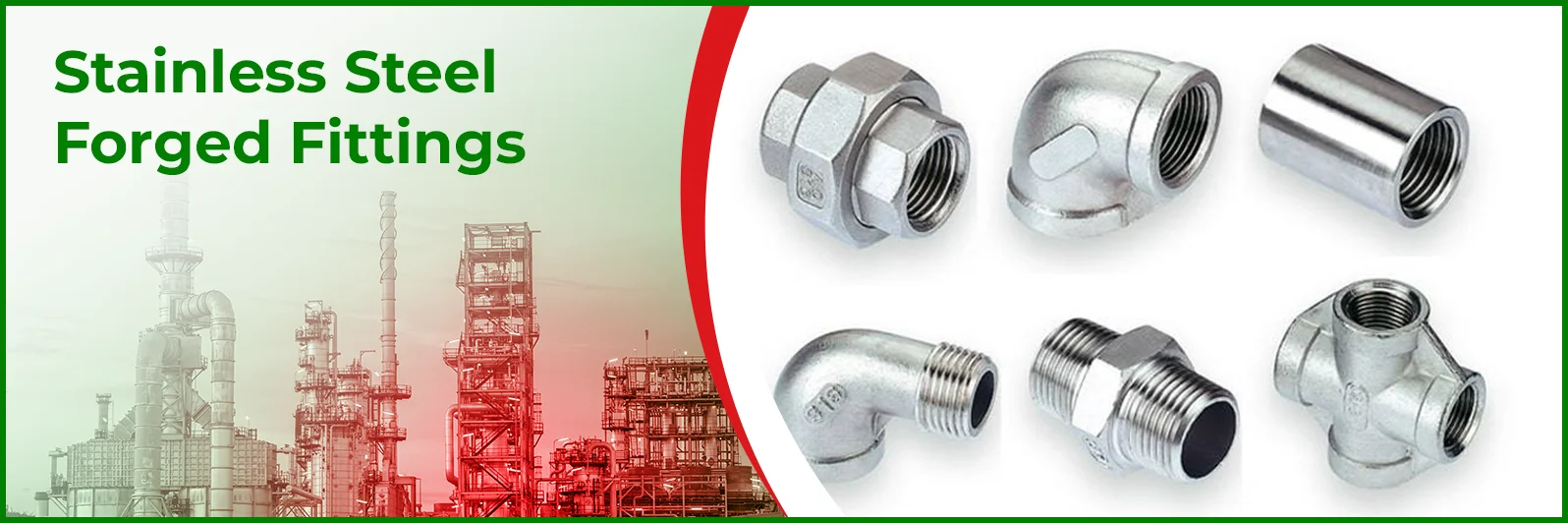
During the forging process, the porosity that was left behind during casting disappears and the grain is bent into the same shape as the part. Because of this, a smaller forged tee can withstand pressure that would not be possible with a cast tee. In carbon steel that is often the end of the process. Stainless steel forged fittings need one more step. The forging temperature runs straight through the band where chromium carbides precipitate at grain boundaries, and only a solution anneal and quench puts that right, which is why plants across Oman and the GCC specify the treatment rather than the grade alone. The wider range is on the stainless steel fittings and flanges hub.
What the Forging Process Does, Good and Bad
| Effect | Consequence for the finished fitting |
|---|---|
Porosity closed under pressure | Sound metal through the section, no cast defects at the bore |
Grain flow follows the contour | Strength where the shape changes, which is where a fitting is loaded |
Worked through the sensitising range | Chromium carbides can precipitate at grain boundaries, locally stripping corrosion resistance |
Residual stress from forming and cooling | Adds to the stress the service applies, which matters for chloride cracking |
Solution annealing answers the last two. The forging is heated high enough to redissolve the carbides, then quenched fast enough that they do not reform on the way down. ASTM A182 requires it for the austenitic grades, and the certificate should name the temperature and the quench medium rather than carrying the word "annealed" on its own.
Pickling and passivation after annealing removes the scale and restores the passive film. Where the service is corrosive or the fitting goes into a clean system, specify it.
Where They Are Used in the GCC
Small bore work on refinery and petrochemical units, desalination and water treatment plants and fertilizer facilities runs heavily on forged stainless: instrument impulse lines, chemical injection, sample connections, drains and vents, and half couplings welded into run pipes for instrument take-offs.
The limitation to watch is the same one that applies to any socket weld joint. The annular crevice at the socket bore holds process fluid, and in chloride-bearing service that crevice concentrates chloride to levels the open surface never sees. Many operator specifications exclude socket weld construction from corrosive service for that reason, regardless of grade.
Our Service
Under NACE MR0175 / ISO 15156 Part 3, austenitic stainless steels are acceptable for sour service within environmental limits on hydrogen sulphide partial pressure, chloride content and temperature, in the solution annealed condition and within a hardness limit. Cold worked material is treated differently from annealed material, which is another reason the heat treatment line on the certificate matters. On socket weld items the fillet weld and heat affected zone must also meet the hardness limit. State the service conditions in the RFQ and the acceptable grade and condition are confirmed against the standard.
What Moves the Price of stainless steel forged fittings
- Material grade and alloy content, which carry market surcharges
- Type, size, pressure class and facing
- Matching pipe schedule or fitting wall
- Forged or wrought, and seamless or welded construction
- Testing: hardness, impact testing, NDT, PMI and ferrite checks where they apply
- Quantity against mill or forge minimums
- Certification level (EN 10204 3.1 or 3.2) and third-party inspection
- Incoterm and destination port
Quotations are available in USD, OMR, AED, SAR, QAR, KWD and BHD, on EXW, FOB, CFR or CIF terms.
What to send for a quotation:
item type, material grade and standard, size, pressure class, facing, schedule or wall, quantity, testing, certification, inspection, destination port and required date.
stainless steel forged fittings Certificates and Inspection
Supplied with EN 10204 3.1 certificates as standard, and EN 10204 3.2 certificates on request. Inspection by the buyer's nominated third-party agency can be arranged; state your requirement in the RFQ. The certificate should carry the material standard and grade, heat number, heat treatment condition and mechanical results, the solution annealing temperature and the quench. PMI on receipt is worth specifying wherever grades share a store or a fabrication shop, since a stencil is only paint. See the MTC and EN 10204 certification guide.
Packing, Delivery and Gulf Site Storage
Lead time is confirmed at quotation. Items are packed in crates or bundles, with bevels and machined faces protected. On Gulf laydown yards the two things that cause rework are a damaged sealing face and surface contamination, so keep face protectors on until assembly and store alloy items clear of carbon steel racking, slings and grinding dust.
Related Stainless Products
- Stainless steel socket weld fittings
- Stainless steel buttweld fittings
- Stainless steel fittings and flanges
- Forged fittings
- Stainless steel 316 flanges
Stainless Steel Forged Fittings FAQ
Why do stainless forgings need solution annealing?
The forging temperature passes through the band where chromium carbides precipitate at grain boundaries, which strips corrosion resistance locally. Solution annealing and a rapid quench redissolve them.
What should the certificate say about heat treatment?
It should name the solution annealing temperature and the quench medium. A certificate that says only annealed leaves the treatment unverified.
Is a threaded Class 3000 fitting the same as a socket weld Class 3000?
No. The class numbers run on different scales. Threaded Class 3000 pairs with Schedule 160 pipe, while socket weld Class 3000 pairs with Schedule 80.
Why are F321 and F347 used instead of the L grades?
They tie carbon up with titanium or niobium rather than removing it, which is the better answer when the service temperature itself sits in the sensitising range.
Should stainless forged fittings be pickled and passivated?
Where the service is corrosive or the system has to be clean, yes. Pickling removes the scale left by annealing and passivation restores the protective film.
What should I send for a quotation?
Send the pattern, connection type, class, grade, NPS, pipe schedule, quantity, pickling and passivation requirements, certification, inspection and destination port.
Request a Quote for Stainless Steel Forged Fittings
Send the pattern, connection type, class, grade and size with quantities, along with the pipe schedule the line is built from. Where the class does not pair with the schedule, or the service makes the socket crevice a risk, that is raised before the offer.