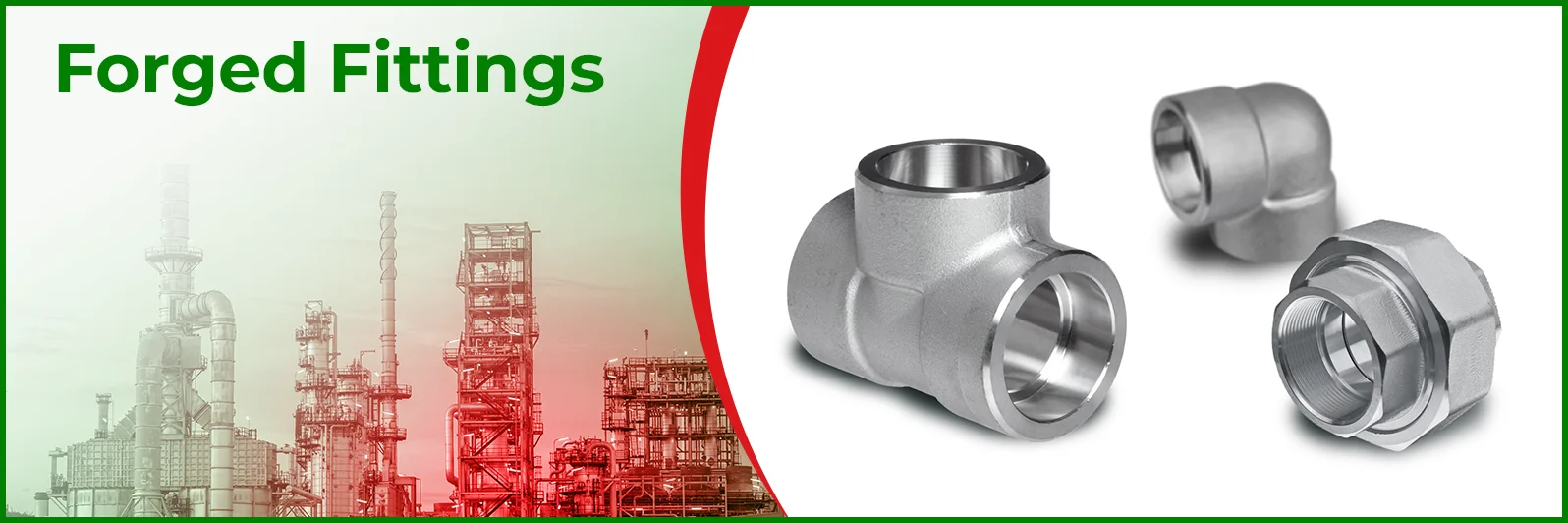
Forging is the process of shaping metal while it is in its hot state, which results in a flow of grains that flows along the shape of the component instead of cutting across it. This is also the reason why a small forged shape is able to withstand pressure that would break a casting of the same dimensions. That grain structure is the whole argument for forged fittings. They cover small bore process, instrument and utility piping across Oman and the GCC in socket weld and threaded patterns, from Class 2000 through Class 9000, in every material family from A105 carbon steel to Hastelloy. The patterns are small, the pressures are not. The wider range sits on the pipe fittings and flanges hub.
Forged Fitting Patterns
| Pattern | Connection | Notes |
|---|---|---|
Elbow, 90 and 45 degree | Socket weld or threaded | The commonest items on any small bore line |
Tee, equal and reducing | Socket weld or threaded | Reducing branches made as a single forging |
Coupling and half coupling | Socket weld or threaded | Half couplings are welded to a run pipe for branch and instrument connections |
Union | Socket weld or threaded | Allows the line to be broken without cutting |
Cap and plug | Socket weld or threaded | Terminations, vents and drains |
Bushing and swage | Threaded | Size transitions on threaded systems |
Boss and outlet | Socket weld or threaded | Instrument and drain take-offs |
Where Forged Fittings Are Used
Small bore work on oil and gas facilities, refinery and petrochemical units and power generation plants runs largely on forged fittings: instrument impulse lines, chemical injection points, drains, vents, sample connections and steam tracing. Half couplings welded into run pipes carry most instrument take-offs. On high pressure boiler and heater piping, forged alloy fittings in F11, F22 and F91 handle both the temperature and the pressure.
Sour Service and Hardness
NACE MR0175 / ISO 15156 applies to forged fittings as it does to the rest of a sour line. For carbon and low-alloy steel forgings that means hardness at or below 22 HRC, controlled chemistry, and an accepted heat treatment condition, normally normalised, or quenched and tempered. Hardness testing on the finished forging is commonly ordered, and on socket weld items the fillet weld and heat affected zone must meet the limit too. For stainless, duplex and nickel alloy forgings, Part 3 of the standard applies and sets environmental limits by alloy. State your sour service requirements in the RFQ.
What Moves the Price of forged fittings
- Material grade and alloy content, which carry market surcharges
- Type, size, pressure class and facing
- Matching pipe schedule or fitting wall
- Forged or wrought, and seamless or welded construction
- Testing: hardness, impact testing, NDT, PMI and ferrite checks where they apply
- Quantity against mill or forge minimums
- Certification level (EN 10204 3.1 or 3.2) and third-party inspection
- Incoterm and destination port
Quotations are available in USD, OMR, AED, SAR, QAR, KWD and BHD, on EXW, FOB, CFR or CIF terms.
What to send for a quotation:
item type, material grade and standard, size, pressure class, facing, schedule or wall, quantity, testing, certification, inspection, destination port and required date.
forged fittings Certificates and Inspection
Supplied with EN 10204 3.1 certificates as standard, and EN 10204 3.2 certificates on request. Inspection by the buyer's nominated third-party agency can be arranged; state your requirement in the RFQ. The certificate should carry the material standard and grade, heat number, heat treatment condition and mechanical results, together with the forging reduction and heat treatment where the specification calls for them. PMI on receipt is worth specifying wherever grades share a store or a fabrication shop, since a stencil is only paint. See the MTC and EN 10204 certification guide.
Packing, Delivery and Gulf Site Storage
Lead time is confirmed at quotation. Items are packed in crates or bundles, with bevels and machined faces protected. On Gulf laydown yards the two things that cause rework are a damaged sealing face and surface contamination, so keep face protectors on until assembly and store alloy items clear of carbon steel racking, slings and grinding dust.
Related Fittings and Flanges
- Socket weld fittings
- Threaded flanges
- Carbon steel forged fittings
- Stainless steel forged fittings
- Buttweld fittings
Forged Fittings FAQ
Is a threaded Class 3000 fitting the same as a socket weld Class 3000 fitting?
No. The class numbers run on different scales. Threaded Class 3000 pairs with Schedule 160 pipe, while socket weld Class 3000 pairs with Schedule 80. Always state the connection type with the class.
When should threaded fittings be avoided?
On hydrocarbon and high pressure service, and anywhere vibration is significant, because threads concentrate stress and provide a leak path. Many operator specifications restrict them or require seal welding.
What size range does ASME B16.11 cover?
NPS 1/8 to NPS 4, for both socket weld and threaded patterns.
Which grades are available as forged fittings?
A105 and A350 LF2 in carbon steel, A182 F11, F22 and F91 in alloy steel, A182 F304L, F316L, F321 and F347 in stainless, A182 duplex grades, and B564 nickel alloys.
Are forged fittings suitable for sour service?
Yes, where they meet NACE MR0175 / ISO 15156, including the 22 HRC hardness limit and an accepted heat treatment condition for carbon and low-alloy grades.
What should I send for a quotation?
Send the pattern, connection type, class, material grade, NPS, quantity, testing, certification, inspection and destination port.
Request a Quote for Forged Fittings
Send the pattern, connection type, class, grade and size with quantities. Where the class and the pipe schedule do not pair correctly, or a threaded item is proposed for a service the piping class restricts, that is raised before the offer goes out.