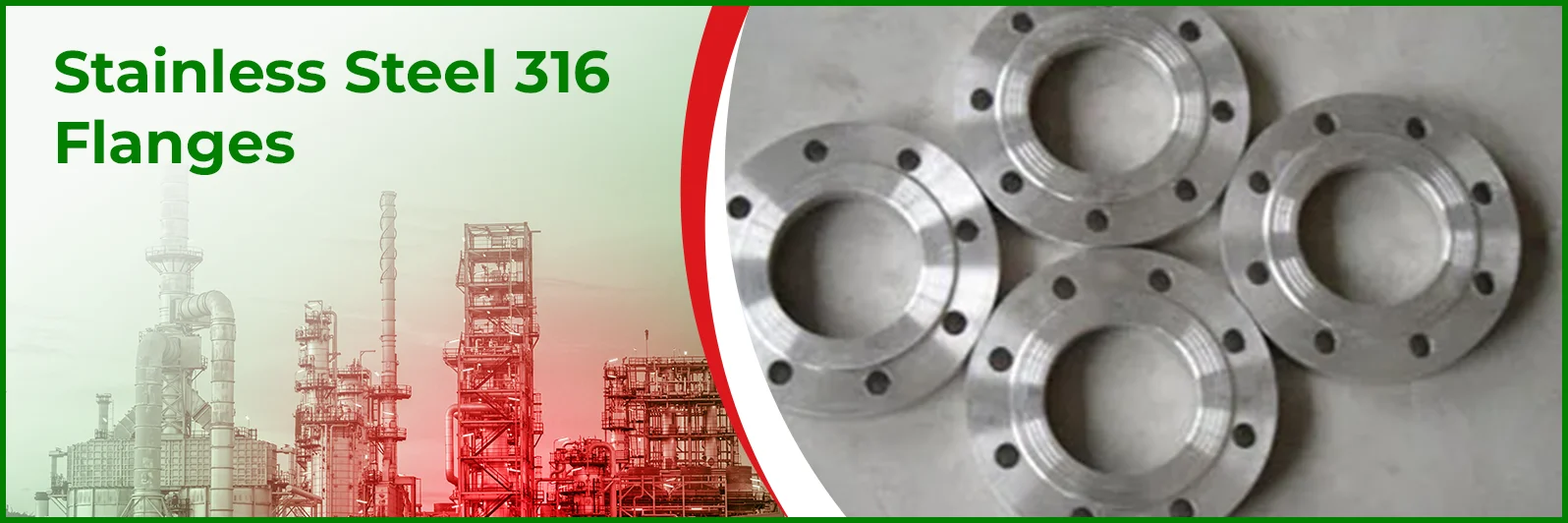
Specifying 316 rather than 304 is a decision about chlorides, paid for in molybdenum, and it is routinely undone at assembly by a set of plain carbon steel studs. In Omani coastal air those studs rust. They stain the face and leave iron on a surface chosen for its resistance to exactly that attack. Stainless steel 316 flanges go onto marine, chemical, desalination and process piping across the GCC, and the joint around them has to be specified as carefully as the flange itself. The wider range is on the stainless steel fittings and flanges hub.
What the Molybdenum Buys
316 steel performs only one main function for molybdenum: stabilizes the passive film against chloride corrosion. Hence, pitting and crevice corrosion will start later and grow slower than in 304. Its weight in the pitting resistance equivalent number reflects that.
PREN is obtained by calculating the percentage of chromium added to 3.3 times the percentage of molybdenum and 16 times the percentage of nitrogen. Since the contribution of one point of molybdenum is more than three times greater than that of chromium, it is clear why even a 2-3% amount of molybdenum makes such a difference to the grades in question.
What it does not buy is immunity. 316 still cracks in warm chloride service, and a gasketed flange face is a crevice by design, so the joint remains the place where attack begins. Where seawater, brine or hot chlorides are the duty, the choice moves to duplex and super duplex.
ASTM A182 F316 and F316L Chemical Composition
| Element | F316 (%) | F316L (%) |
|---|---|---|
Carbon | 0.08 max | 0.030 max |
Chromium | 16.0 to 18.0 | 16.0 to 18.0 |
Nickel | 10.0 - 15.0 | 10.0 to 14.0 |
Molybdenum | 2.00 to 3.00 | 2.00 to 3.00 |
Manganese | 2.00 max | 2.00 max |
Silicon | 1.00 max | 1.00 max |
Phosphorus | 0.045 max | 0.045 max |
Sulphur | 0.030 max | 0.030 max |
Nitrogen | 10.0 max | 10.0 max |
Molybdenum is specified as a range, not a single figure, so a flange at the bottom of the band is a different piece of metal from one at the top where chlorides are concerned. On critical duty, ask for the molybdenum result on the certificate rather than accepting the grade name.
Bolting, Gaskets and Galvanic Pairs
The flange is one part of a joint that has four: flange, gasket, bolting and the pipe behind it. Three points that decide how long it lasts in Gulf conditions.
Bolting material. ASTM A193 B8 or B8M studs with A194 Grade 8 or 8M nuts keep the joint consistent with the flange. Plain carbon steel studs rust in coastal humidity, stain the face and leave iron deposits on a surface chosen to resist chloride attack.
Galling. Stainless studs and nuts gall against each other under load. An anti-seize compound compatible with the service is standard practice, and the compound must be low in chlorides and sulphur.
Mixed metal joints. Where a 316 flange bolts to carbon steel equipment, the pair is galvanic and the coastal environment supplies the electrolyte. An isolation kit with a sleeve and washers is the usual answer.
Sour Service
Under NACE MR0175 / ISO 15156 Part 3, austenitic stainless steels including 316 are acceptable for sour service within defined environmental limits covering hydrogen sulphide partial pressure, chloride content and temperature, in the solution annealed condition and within a hardness limit. These are specific conditions rather than a blanket approval. Send the full service envelope with the enquiry and the acceptable grade can be confirmed against the standard.
Stainless Steel 316 Flanges: Price Factors
Each enquiry is priced on its own, because grade, class and testing scope move the figure more than quantity does. What counts:
- Grade and the alloying elements it carries
- Size, pressure class, facing and bore
- Schedule or wall the item is made to
- Production route, forged or formed from pipe or plate
- Supplementary testing and inspection scope
- Order quantity and availability
- Certificate level and witness requirements
- Delivery terms and port of discharge
Quotations are available in USD, OMR, AED, SAR, QAR, KWD and BHD, on EXW, FOB, CFR or CIF terms.
What to send for a quotation:
item type, material grade and standard, size, pressure class, facing, schedule or wall, quantity, testing, certification, inspection, destination port and required date.
Certification, Traceability and PMI
Material comes with EN 10204 3.1 certificates as standard, and EN 10204 3.2 certificates on request. Inspection by the buyer's nominated third-party agency can be arranged; state your requirement in the RFQ. Check that the heat number on the certificate matches the marking on the item itself, and that the heat treatment condition is stated, the solution annealing treatment and the molybdenum content against the grade range. Positive material identification confirms the grade before anything is welded in. See the MTC and EN 10204 certification guide.
Delivery and Handling
Lead time is confirmed at quotation. Fittings ship bundled or crated with bevel protection; flanges ship with face and ring groove protection, since a scored face leaks whatever the gasket. In coastal Oman, salt deposits build up on anything left in the open, so a rinse and a dry before fitting up is worth the time.
Related Stainless Products
- Stainless steel 304 flanges
- Stainless steel fittings and flanges
- Stainless steel socket weld fittings
- Stainless steel 316 / 316L pipes and tubes
- Duplex fittings and flanges
Stainless Steel 316 Flanges: Buyer Questions
What does molybdenum do in 316?
It stabilises the passive film against chloride attack, so pitting and crevice corrosion start later than in 304. In the PREN calculation each point of molybdenum counts more than three times a point of chromium.
Can 316 flanges be used in seawater?
Not reliably. 316 still suffers chloride stress corrosion cracking in warm chloride service, and the gasket crevice is where it usually starts. Duplex or super duplex is the normal answer.
What bolting should be used with 316 flanges?
ASTM A193 B8M studs with A194 Grade 8M nuts, with a low chloride anti-seize compound to prevent galling. Carbon steel studs rust in coastal air and contaminate the flange face.
What does a 316/316L dual certified marking mean?
The item meets 316L chemistry and 316 mechanical properties. The pressure rating follows the lower group unless the certificate carries the evidence for the higher one.
Should I ask for the molybdenum result on the certificate?
On chloride-critical duty, yes. Molybdenum is specified as a 2.00 to 3.00 percent range, and a flange at the bottom of that band behaves differently from one at the top.
What should I send for a quotation?
Send the pattern, NPS, pressure class, facing, bore schedule, quantity, service conditions, certification, inspection and destination port.
Request a Quote for Stainless Steel 316 Flanges
Send the pattern, size, class, facing and bore schedule with quantities, and say what the line carries. Where chlorides and temperature push past what 316 will hold, the alternative grade is put forward with the offer.