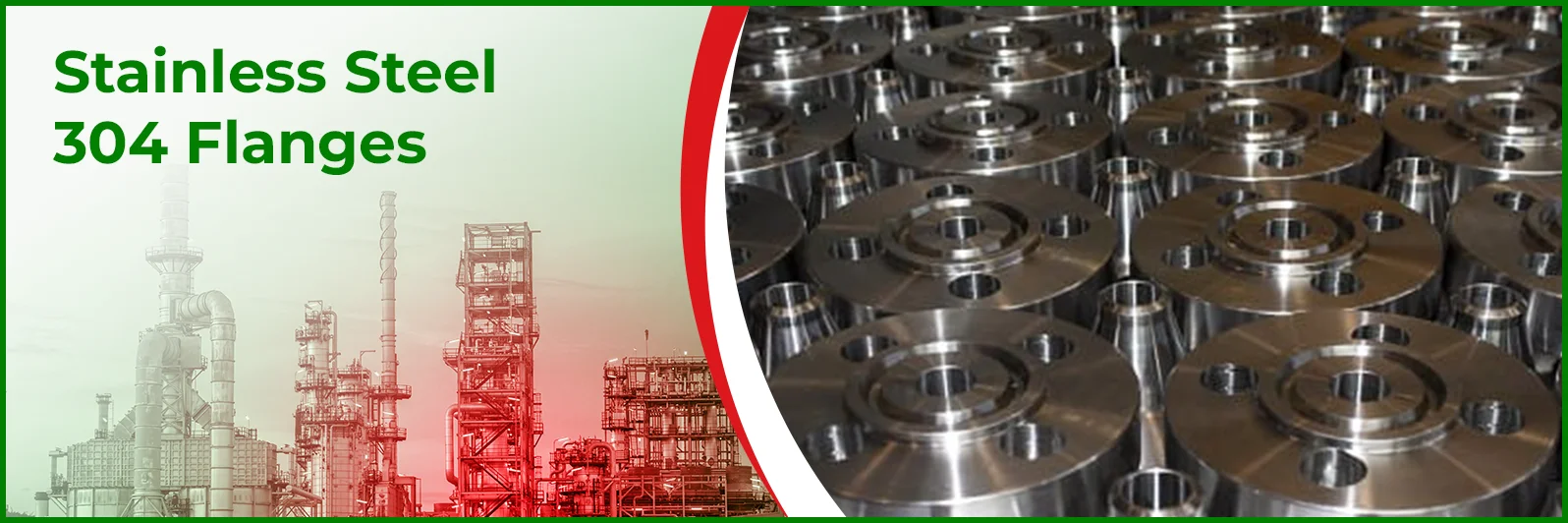
The raised face on a flange is not meant to be polished. In conformity with ASME B16.5 guidelines, serrated symmetric and spiral patterns can be expected that have surface roughness between 3.2 micrometers and 6.3 micrometers. Spiral wound gaskets achieve sealing through penetration into such reflections, whereas smooth surfaces of flanges do not allow for grip. Stainless steel 304 flanges turn up on process, utility and water systems across Oman and the GCC, and a smooth face is one of the more common reasons a new joint weeps on first pressurisation. The wider range is on the stainless steel fittings and flanges hub.
Gasket Seating Surface, and Why It Decides the Seal
| Facing and finish | Where it belongs |
|---|---|
Serrated concentric or spiral, roughness 3.2 to 6.3 micrometres | The ASME B16.5 standard finish, suits spiral wound and most composite gaskets |
Smooth finish | Used with soft full-face gaskets such as elastomer or PTFE sheet |
Flat face | Mating to cast iron or equipment that cannot take an edge load |
Three points that save rework:
- Match the finish to the gasket, not to appearance. A spiral wound gasket on a smooth face is a leak waiting to happen, and so is a soft PTFE sheet on a deeply serrated one.
- Protect the face in transit and storage. A single radial scratch across the serrations gives the process a path out. Face protectors stay on until the joint is bolted.
- Scrape the old gasket carefully. A carbon steel scraper on a stainless face embeds iron, which rusts and then pits. Use stainless or non-metallic tools.
Where 304 Works, and Where It Does Not
304 suits general process piping, treated water, steam condensate, food and beverage service, and much of the utility network inside a refinery or petrochemical plant. It is specified widely on the low chloride side of desalination and water treatment plants.
It is the wrong choice for seawater, brine and warm chloride service. Chloride stress corrosion cracking attacks 304 above moderate temperature, and a gasketed flange face is a crevice by design, so the joint is usually where the attack starts. For chloride duty the choice moves to stainless steel 316 flanges, then to duplex.
Sour Service and Bolting
Under NACE MR0175 / ISO 15156 Part 3, austenitic stainless steels are acceptable within defined environmental limits on hydrogen sulphide partial pressure, chloride content and temperature, in the solution annealed condition and within a hardness limit. Send the service conditions and the acceptable grade can be confirmed.
Bolting is worth stating on the order. A stainless flange set assembled with plain carbon steel studs will rust at the bolt holes in coastal Omani air, and the rust stains the flange face. B8 or B8M stainless bolting, or coated alloy studs, keeps the joint consistent with the flange.
What Moves the Price of Stainless Steel 304 Flanges
- Material grade and alloy content, which carry market surcharges
- Type, size, pressure class and facing
- Matching pipe schedule or fitting wall
- Forged or wrought, and seamless or welded construction
- Testing: hardness, impact testing, NDT, PMI and ferrite checks where they apply
- Quantity against mill or forge minimums
- Certification level (EN 10204 3.1 or 3.2) and third-party inspection
- Incoterm and destination port
Quotations are available in USD, OMR, AED, SAR, QAR, KWD and BHD, on EXW, FOB, CFR or CIF terms.
What to send for a quotation:
item type, material grade and standard, size, pressure class, facing, schedule or wall, quantity, testing, certification, inspection, destination port and required date.
Stainless Steel 304 Flanges: Certificates and Inspection
Supplied with EN 10204 3.1 certificates as standard, and EN 10204 3.2 certificates on request. Inspection by the buyer's nominated third-party agency can be arranged; state your requirement in the RFQ. The certificate should carry the material standard and grade, heat number, heat treatment condition and mechanical results, the solution annealing treatment and the dual certification if the item is marked 304/304L. PMI on receipt is worth specifying wherever grades share a store or a fabrication shop, since a stencil is only paint. See the MTC and EN 10204 certification guide.
Packing, Delivery and Gulf Site Storage
Lead time is confirmed at quotation. Items are packed in crates or bundles, with bevels and machined faces protected. On Gulf laydown yards the two things that cause rework are a damaged sealing face and surface contamination, so keep face protectors on until assembly and store alloy items clear of carbon steel racking, slings and grinding dust.
Related Stainless Products
- Stainless steel 316 flanges
- Stainless steel fittings and flanges
- Stainless steel buttweld fittings
- Stainless steel 304 / 304L pipes and tubes
- Weld neck flanges
Stainless Steel 304 Flanges FAQ
What surface finish should a 304 flange face have?
The ASME B16.5 standard finish is a serrated concentric or spiral pattern with a roughness of 3.2 to 6.3 micrometres, which suits spiral wound gaskets. A smooth face suits soft full-face gaskets instead.
What is the difference between F304 and F304L?
Carbon content. F304L is limited to 0.030 percent, which reduces chromium carbide precipitation during welding, so it is the usual choice for fabricated systems.
Why is a Class 150 stainless flange rated lower than carbon steel?
The low carbon austenitic grades sit in ASME B16.5 Material Group 2.3 at 15.9 bar for Class 150, against 19.6 bar for Group 1.1 carbon steel, because the allowable stress is lower at ambient temperature.
What does a 304/304L dual certified marking mean for the rating?
It means the item meets 304L chemistry and 304 mechanical properties. The pressure rating follows the lower group unless the certificate supports the higher one.
Can 304 flanges be used in seawater?
No. Chloride stress corrosion cracking attacks 304 in warm chloride service, and the flange crevice is a common initiation point. Use 316, duplex or a higher alloy.
What should I send for a quotation?
Send the pattern, NPS, pressure class, facing, surface finish, bore schedule, quantity, certification, inspection and destination port.
Request a Quote for Stainless Steel 304 Flanges
Send the pattern, size, class, facing and bore schedule with quantities, and state the gasket type so the face finish is quoted to match it. Dual certification and heat treatment condition are confirmed on the offer.