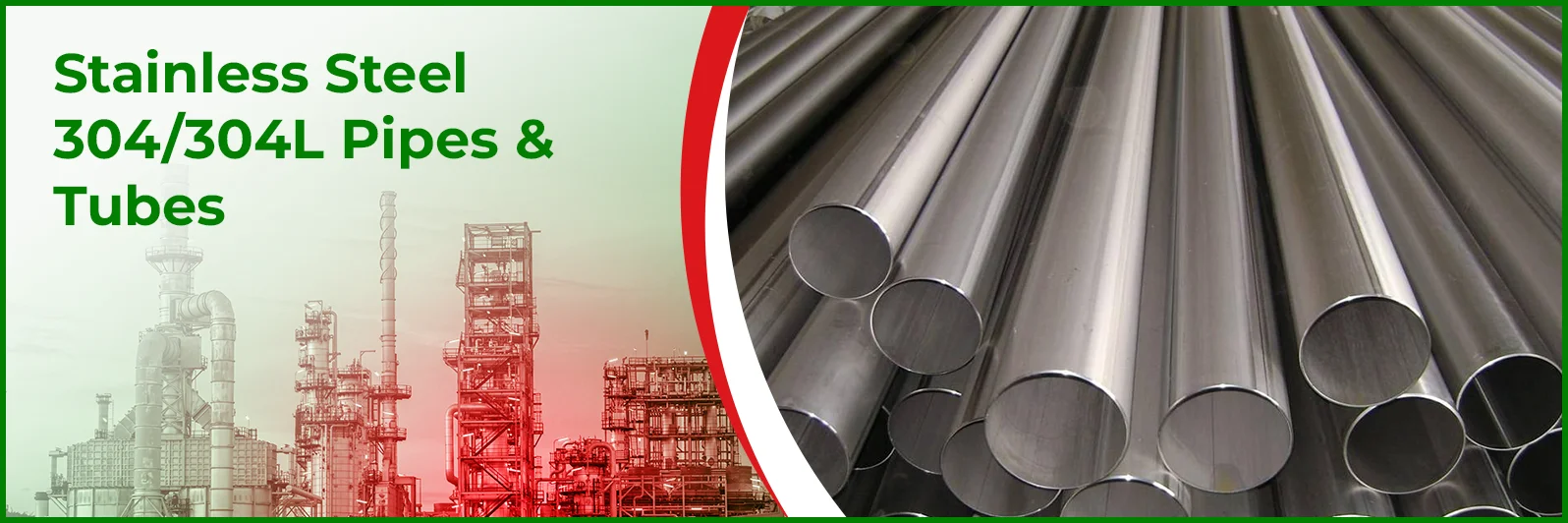
A dual certified 304/304L order asks one heat to do two jobs at once: carbon low enough for the L grade so welds resist sensitisation, and strength high enough to claim 304 allowable stresses in design. Mills can do it, but only when the heat is selected for it. Our stainless steel 304 304L pipes and tubes are supplied to ASTM A312 for pipe and A213 or A269 for tube, seamless or welded. They run through process, utility and water systems in plants across Oman. Other grades are on the stainless steel pipes and tubes hub.
Where 304 and 304L Are Used
- Process and utility piping in refineries, chemical and fertilizer plants, away from strong chlorides
- Food, beverage and pharmaceutical systems, where cleanliness matters more than chloride resistance
- Potable and demineralised water lines
- Steam and condensate in moderate service
- Structural and architectural work, handrails and supports
In coastal atmospheres, chloride-bearing process streams or seawater service, 316 / 316L is normally specified instead. For high-temperature service with welding, 321 or 347 are used.
304 vs 304L: The Practical Difference
|
Property |
TP304 |
TP304L |
|---|---|---|
|
Carbon |
0.08% max |
0.035% max |
|
Chromium |
18.0 to 20.0% |
18.0 to 20.0% |
|
Nickel |
8.0 to 11.0% |
8.0 to 13.0% |
|
Minimum tensile strength |
515 MPa (75,000 psi) |
485 MPa (70,000 psi) |
|
Minimum yield strength |
205 MPa (30,000 psi) |
170 MPa (25,000 psi) |
|
Main advantage |
Higher design strength |
Better resistance to sensitisation when welded |
Dual certification in practice
A heat that analyses at 0.025% carbon and tests at 235 MPa yield meets the L grade chemistry and exceeds the 205 MPa yield of plain 304, so it can be certified as 304/304L. A heat at 0.025% carbon but 185 MPa yield meets only 304L. A heat at 0.05% carbon can never be 304L, however strong it is. Asking for dual certification at enquiry stage lets the mill select a suitable heat; asking after rolling rarely works.
Corrosion Limits and Sour Service
304 and 304L resist general corrosion well in clean water, steam and many chemicals, but they pit in chloride-bearing environments and are susceptible to chloride stress corrosion cracking at raised temperatures, including under wet insulation on coastal sites. Under NACE MR0175 / ISO 15156-3, austenitic grades are acceptable only within defined limits of H2S, chloride, temperature and pH, and 304L is the least tolerant of the common grades. State your service conditions in the RFQ; requirements are confirmed at quotation.
Price Factors for 304 and 304L
- Nickel surcharge, which moves with the market
- Seamless or welded
- Size, schedule and length
- Dual certification
- Finish, including polished or bright annealed
- Testing such as A262 and PMI
- Quantity and stock availability versus a mill order
- Certification (EN 10204 3.1 or 3.2) and third-party inspection
- Incoterm and destination port
Quotations are available in USD, OMR, AED, SAR, QAR, KWD and BHD, on EXW, FOB, CFR or CIF terms.
What to send for a quotation:
grade (304, 304L or dual certified), standard, seamless or welded, NPS or OD, schedule or wall, length, quantity, finish, testing, certification, inspection, destination port and required date.
Certificates and Inspection
304 and 304L pipe and tube are supplied with EN 10204 3.1 certificates as standard, and EN 10204 3.2 certificates on request. Inspection by the buyer's nominated third-party agency can be arranged; state your requirement in the RFQ. Check the carbon result if dual certification is required, along with solution annealing details, tensile results and any corrosion test report. See the MTC and EN 10204 certification guide.
Handling and Storage
Lead time is confirmed at quotation. Material ships capped and, where specified, wrapped to protect the finish. Store it clear of carbon steel, use dedicated slings and tools, and avoid carbon steel dust from nearby grinding, since embedded iron rusts and can trigger pitting. Rinse salt deposits off pipe stored on coastal sites before fabrication.
Fittings and Flanges for 304 and 304L Lines
Match with ASTM A403 WP304/WP304L buttweld fittings and ASTM A182 F304/F304L flanges and forged fittings:
- Stainless steel fittings and flanges hub
- Stainless steel 304 welded pipe and tube
- SS 304 instrumentation tubing
304 and 304L are used across refinery and petrochemical, fertilizer and desalination and water treatment plants.
SS 304 and 304L FAQ
What is the difference between 304 and 304L?
304L has lower carbon (0.035% max against 0.08%), which improves resistance to sensitisation when welded. 304 has higher minimum tensile and yield strength.
What does 304/304L dual certified mean?
One heat that meets 304L chemistry and 304 mechanical properties, so the certificate shows both grades. It must be requested at enquiry stage.
Is 304 suitable for coastal Gulf conditions?
Often not. Salt-laden air pits 304 and can cause chloride stress corrosion cracking, so 316L or a higher grade is usually specified near the coast.
What is the EN equivalent of 304L?
1.4307 (X2CrNi18-9). Plain 304 corresponds to 1.4301.
Which standard covers 304L pipe?
ASTM A312 for pipe, with A213 or A269 for tube. State which applies on the enquiry.
What should I send for a quotation?
Send the grade, standard, form, size, wall, length, quantity, finish, testing, certification, inspection, destination port and required date.
Request a Quote for 304 and 304L Pipes and Tubes
Send the grade, standard, size, wall and quantity, and state whether dual certification is required. Every enquiry is checked against ASTM A312 or A213 before the offer is prepared, so a 304 line specified for chloride service is raised at the start.