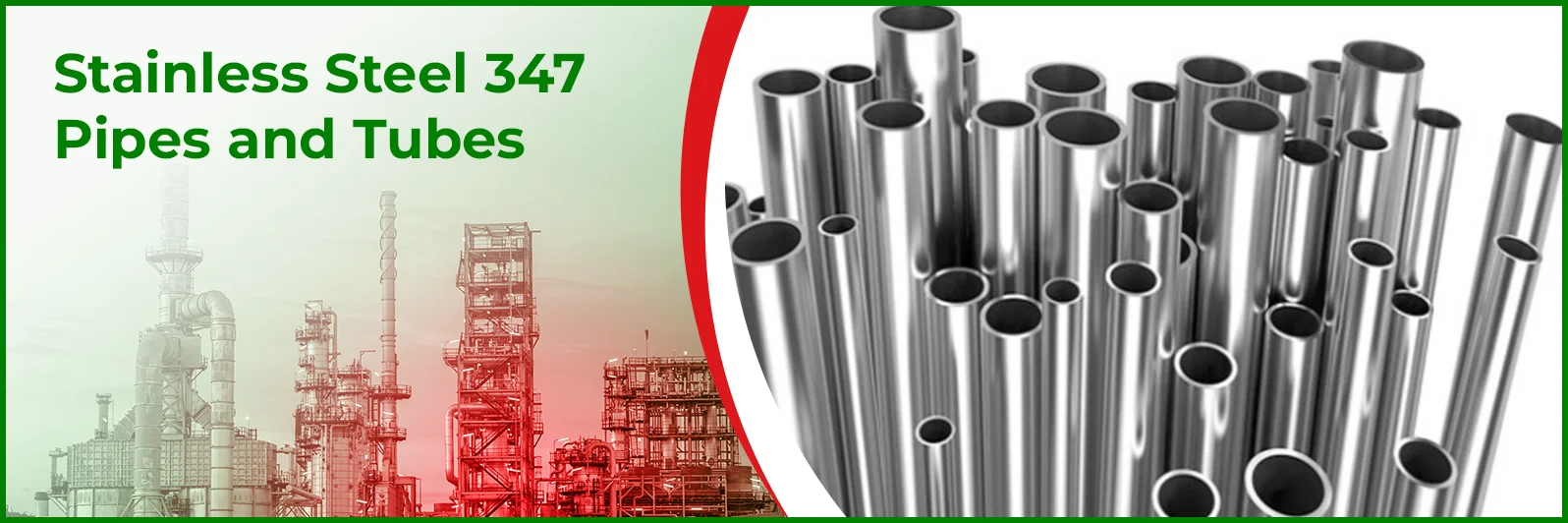
Niobium survives the welding arc where titanium burns off, so 347 is the grade that can be both the pipe and the filler metal, and fabrication shops running stabilised austenitic lines usually keep 347 consumables regardless of which stabilised grade the pipe is. One grade covers both roles. Stainless steel 347 tubular products have a niobium content that is ten times higher than that of carbon. as a result, the carbon is held in place without hindering the chromium content from being dissolved. these tubular steel constructions are immune to grain boundaries cracking after their welding and are efficient in high-temperature operations in refineries and power generation plants in Oman. Other grades are on the stainless steel pipes and tubes hub.
Where 347 Pipes and Tubes Are Used
- High-temperature refinery and petrochemical process lines
- Superheater and reheater tubes within code limits
- Exhaust ducting, expansion joints and stacks
- Welded assemblies operating hot, where sensitisation must be avoided
- Filler metal for welding 321 and other stabilised grades
The titanium-stabilised alternative is 321; for general service, 304/304L is more economical.
Where 347 Fits Among the Austenitic Grades
| Grade | Stabilising element | Typical reason for choosing it |
|---|---|---|
| 304L | None; low carbon instead | General welded service at moderate temperature |
| 321 | Titanium | High-temperature welded service, economical stabilised option |
| 347 | Niobium | High-temperature service where stabilisation must survive welding, and for filler metal |
| 316L | None; molybdenum for chlorides | Chloride-bearing or coastal service |
347's niobium content is specified as a multiple of carbon, like the titanium in 321, so both elements must be read against the carbon result on the certificate. Where the design requires creep strength at high temperature, 347H carries controlled higher carbon, and dual certified 347/347H material is available when both limits are met.
347 Corrosion Behaviour
347 resists intergranular corrosion after welding and prolonged high-temperature exposure. Like 321, it offers no more chloride resistance than 304, so coastal and chloride-bearing service calls for 316L or higher. Under NACE MR0175 / ISO 15156-3, austenitic grades are acceptable only within defined limits. State your service conditions in the RFQ; requirements are confirmed at quotation.
Pricing 347 Pipe and Tube
- Raw material surcharges for the alloying elements in this grade
- Seamless or welded construction
- Diameter, wall thickness and cut lengths
- Required finish and cleanliness
- Testing, certification level and witness requirements
- Quantity and availability
- Incoterm and port of discharge
Quotations are available in USD, OMR, AED, SAR, QAR, KWD and BHD, on EXW, FOB, CFR or CIF terms.
What to send for a quotation:
grade, standard, seamless or welded, NPS or OD, schedule or wall, length, quantity, finish, testing, certification, inspection, destination port and required date.
Mill Certificates and Verification
347 is supplied with EN 10204 3.1 certificates as standard, and EN 10204 3.2 certificates on request. Inspection by the buyer's nominated third-party agency can be arranged; state your requirement in the RFQ. The certificate should record chemistry, heat treatment, tensile properties and any additional testing ordered. Positive material identification is worth specifying wherever several stainless grades share a fabrication shop. See the MTC and EN 10204 certification guide.
Storage and Contamination Control
Lead time is confirmed at quotation. Material is capped and, where specified, wrapped to protect the surface. Iron contamination is the main storage risk: carbon steel tools, slings and airborne grinding dust all leave particles that rust and can trigger pitting, so segregation on the Gulf laydown yard matters as much as the original grade choice.
Fittings and Related Grades
Match with ASTM A403 WP347 fittings and ASTM A182 F347 flanges.
- stainless steel fittings and flanges hub
- Stainless steel 321 pipes and tubes
- Stainless steel 310/310S pipes and tubes
347 is used across refinery and petrochemical and power generation plants.
SS 347 FAQ
What is 347 stainless steel?
An austenitic stainless steel stabilised with niobium, which prevents chromium carbide formation during welding and high-temperature service.
Why is 347 used as filler metal for 321?
Titanium is lost across the welding arc, while niobium survives it, so 347 consumables are used to weld titanium-stabilised 321 pipe.
What is 347H?
A version with controlled higher carbon for creep strength, used where the design code requires it.
Does 347 resist chlorides better than 304?
No. Its stabilisation addresses sensitisation, not pitting. Use 316L or higher in chloride service.
What is the EN equivalent of 347?
1.4550 (X6CrNiNb18-10).
What should I send for a quotation?
Send the grade, standard, form, size, wall, length, quantity, finish, testing, certification, inspection and destination port.
Request a Quote for Stainless Steel 347 Pipes and Tubes
Send the grade, standard, size and quantity, with the piping specification attached. Every enquiry is checked before the offer is prepared, so 347H requirements and filler metal questions are settled at the start.