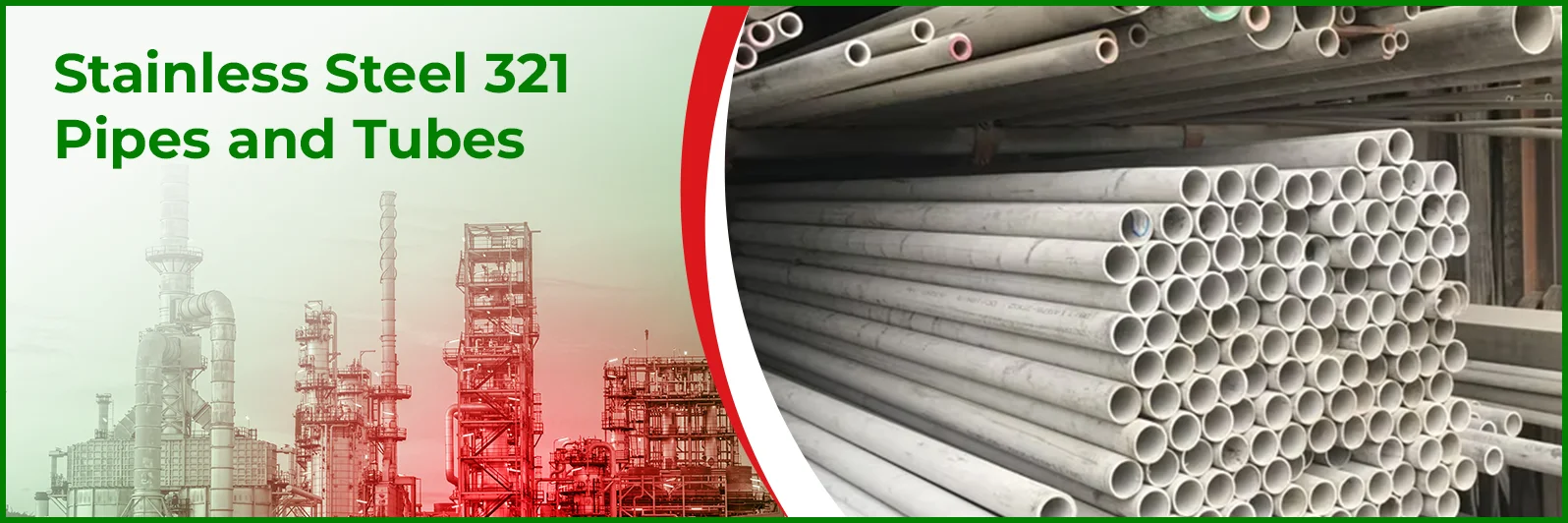
Low carbon alone protects a welded austenitic line only until the steel spends real time at high temperature, when carbon eventually finds chromium and forms carbides at the grain boundaries anyway. Titanium removes that possibility by locking the carbon up first. That is the whole point of stainless steel 321 pipes and tubes, which carry titanium at several times the carbon content. Stabilised that way, they hold their corrosion resistance through welding and years of hot service in refineries and process plants across Oman. Related grades are on the stainless steel pipes and tubes hub.
Where 321 Pipes and Tubes Are Used
- High-temperature process piping in refineries and petrochemical plants
- Expansion joints, bellows and flexible connections
- Exhaust systems, ducting and stacks
- Heat exchanger and superheater tubes within code limits
- Chemical plant lines welded and then operated hot
The niobium-stabilised alternative is 347. For lower temperatures, 304/304L is more economical.
Stabilised or Low Carbon: Two Ways to Beat Weld Decay
| Approach | How it works | Where it falls short |
|---|---|---|
| L grade (304L, 316L) | Low carbon slows chromium carbide formation during welding | Long service at high temperature can still sensitise the steel |
| Stabilised (321, 347) | Titanium or niobium combines with carbon first, leaving chromium in solution | Slightly higher cost; filler metal selection needs care |
A practical detail about welding 321. Titanium is lost across the arc, so matching 321 filler wire is not normally used. Niobium-stabilised 347 filler is the standard choice for welding 321 pipe, which is one reason both grades often appear on the same project. State the filler requirement in the fabrication specification rather than assuming a matching consumable exists.
321 or 321H? 321H has controlled higher carbon for creep strength where the design code calls for it. Dual certified 321/321H material is available when both sets of limits are met.
321 Corrosion Behaviour
321 resists intergranular attack after welding and high-temperature service, which is its main advantage over 304L. Its chloride resistance is no better than 304, so it pits in coastal or chloride-bearing conditions and is not a substitute for 316L there. Under NACE MR0175 / ISO 15156-3, austenitic grades are acceptable only within defined limits of H2S, chloride, temperature and pH. State your service conditions in the RFQ; requirements are confirmed at quotation.
321 Price Factors
Each enquiry is quoted individually, since alloy surcharges move week to week. What changes the figure:
- Grade and alloy content
- Product form, size and wall
- Finish, cleaning and passivation
- Supplementary tests and PMI
- Order quantity against mill minimums
- Stock or mill order
- Certificate level and inspection scope
- Delivery terms and destination port
Quotations are available in USD, OMR, AED, SAR, QAR, KWD and BHD, on EXW, FOB, CFR or CIF terms.
What to send for a quotation:
grade, standard, seamless or welded, NPS or OD, schedule or wall, length, quantity, finish, testing, certification, inspection, destination port and required date.
Certification, PMI and Inspection
Material comes with EN 10204 3.1 certificates as standard, and EN 10204 3.2 certificates on request. Inspection by the buyer's nominated third-party agency can be arranged; state your requirement in the RFQ. For 321, review the chemistry, annealing details and mechanical results, and specify PMI so each item is verified before it goes into the line. See the MTC and EN 10204 certification guide.
Handling 321 on Site
Lead time is confirmed at quotation. Pipe and tube arrive capped, and wrapped where the finish requires it. Store on timber or plastic, not on carbon steel, and use dedicated slings, brushes and grinding discs. Salt-laden coastal air leaves deposits on stored material, so a rinse before welding is worth the time.
Fittings and Related Grades
Match with ASTM A403 WP321 fittings and ASTM A182 F321 flanges, and specify 347 filler metal for welding.
- stainless steel fittings and flanges hub
- Stainless steel 347 pipes and tubes
- Stainless steel 310/310S pipes and tubes
321 is used across refinery and petrochemical and power generation plants.
SS 321 FAQ
Why is 321 stabilised with titanium?
Titanium combines with carbon before chromium can, preventing chromium carbide formation at grain boundaries during welding and high-temperature service.
What is the difference between 321 and 347?
347 uses niobium instead of titanium. Niobium survives the welding arc, so 347 is also the standard filler metal for welding 321.
Is 321 better than 304L?
For high-temperature welded service, yes, because stabilisation is permanent. For chloride resistance, neither is suitable; 316L or higher is needed.
What is 321H?
A version with controlled higher carbon for creep strength at high temperature, used where the design code requires it.
What is the EN equivalent of 321?
1.4541 (X6CrNiTi18-10).
What should I send for a quotation?
Send the grade, standard, form, size, wall, length, quantity, finish, testing, certification, inspection and destination port.
Request a Quote for Stainless Steel 321 Pipes and Tubes
Send the grade, standard, size and quantity, with the piping or fabrication specification attached. Every enquiry is checked before the offer is prepared, so filler metal and 321H requirements are settled at the start.