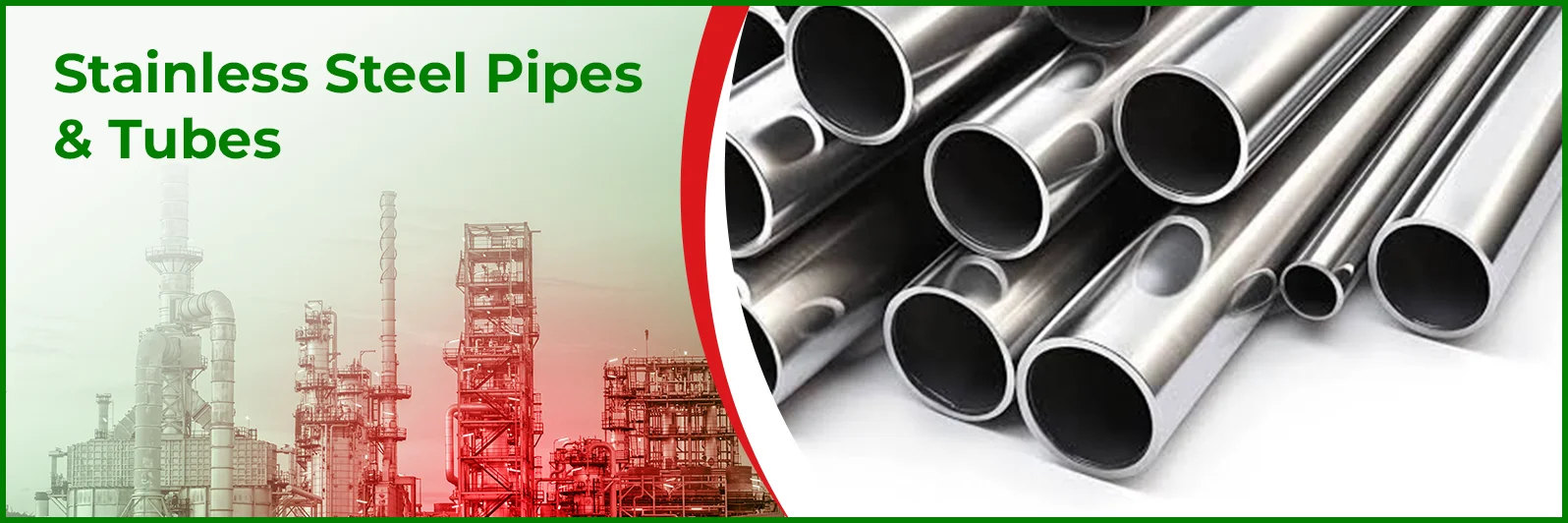
The term stainless does not indicate that a material is stain-proof, especially as one coastal plant reveals: 304 will corrode in a matter of a couple of years in salt air and warm environment, while the same grade of 316L or a more advanced alloy remains spotless. Chlorides decide the grade here more often than temperature does. Our stainless steel pipes and tubes cover austenitic, ferritic and high-alloy grades in seamless and welded form, along with instrumentation tubing. They serve process, utility, cooling water and potable water systems at plants across the GCC. Other material families sit on the pipes and tubes hub.
Choosing a Stainless Grade
Service condition | Usual grades | Why |
|---|---|---|
General process and utility, inland, low chloride | Economical austenitic workhorse | |
Coastal atmosphere, chloride-bearing process, marine air | Molybdenum improves pitting resistance | |
High temperature, cyclic heat | High chromium and nickel resist scaling | |
High temperature with welding, risk of sensitisation | Titanium or niobium stabilise the carbides | |
Sulphuric and phosphoric acid, aggressive chlorides | High nickel, molybdenum and copper | |
Seawater and high-chloride brines | 6% molybdenum super austenitic | |
Exhaust, mild service, cost-sensitive | Ferritic grades, lower cost, no nickel | |
Wear and moderate corrosion | Martensitic, hardenable | |
Chloride-rich water at moderate temperature | Ferritic with molybdenum, resists chloride cracking | |
Very high temperature, sulphur-bearing atmospheres | High chromium ferritic |
Where chlorides and temperature together exceed austenitic limits, duplex and super duplex pipes are the usual next step.
Product Forms
Stainless Steel Seamless Pipes and Tubes
Seamless stainless is specified for pressure, cyclic and high-purity service, and for small bores. It covers ASTM A312 pipe and A213 or A269 tube. See stainless steel seamless pipes and tubes.
Stainless Steel Welded Pipes and Tubes
Welded stainless to ASTM A312 or A358 is more economical in larger diameters and thinner walls, and is standard for many utility, water and structural applications. See stainless steel welded pipes and tubes.
Stainless Steel Instrumentation Tubing
Small-bore, tight-tolerance tubing for impulse lines, analyser lines and hydraulic control, usually in 316 or 304. See stainless steel instrumentation tubing.
Stainless in Sour Service
Austenitic stainless steels fall under NACE MR0175 / ISO 15156-3, which sets limits on H2S partial pressure, chloride content, temperature and pH for each alloy group. 316L is acceptable only within narrow limits, while duplex, super duplex and high-nickel alloys go further. State your sour service conditions in the RFQ; requirements are confirmed at quotation. See the NACE MR0175 sour service guide.
Price Factors
- Grade, since nickel and molybdenum content dominate cost
- Seamless or welded
- Size, wall and length
- Surface finish, pickling and passivation
- Testing: intergranular corrosion, ferrite, positive material identification
- Quantity and stock availability versus a mill order
- Certification (EN 10204 3.1 or 3.2) and third-party inspection
- Incoterm and destination port
Quotations are available in USD, OMR, AED, SAR, QAR, KWD and BHD, on EXW, FOB, CFR or CIF terms.
What to send for a quotation: grade, seamless or welded, NPS or OD, schedule or wall, length, quantity, finish, testing, certification, inspection, destination port and required date.
Certificates, PMI and Inspection
Stainless pipe and tube are supplied with EN 10204 3.1 certificates as standard, and EN 10204 3.2 certificates on request. Inspection by the buyer's nominated third-party agency can be arranged; state your requirement in the RFQ. PMI is worth specifying wherever stainless and carbon steel are fabricated in the same shop. See the MTC and EN 10204 certification guide.
Handling Stainless on Site
Lead time is confirmed at quotation. Stainless ships with end caps and, where specified, plastic wrapping to protect the finish. Keep it apart from carbon steel at every stage: separate racks, dedicated grinding discs and brushes, and no carbon steel slings or chains, since embedded iron particles rust and start pitting. On coastal sites, wash salt deposits off stored pipe before fabrication.
Fittings and Flanges
Stainless pipe and tube are used across refinery and petrochemical, desalination and water treatment, fertilizer and LNG and gas processing plants.
Stainless Steel Pipes and Tubes FAQ
Which stainless grade should I use in a coastal plant?
316L or higher is the usual minimum where salt-laden air reaches the pipe. 304 pits quickly in chloride-bearing coastal conditions.
What is the difference between 304 and 304L?
Carbon content. 304L has lower carbon, which reduces sensitisation during welding; 304 has slightly higher strength.
When is 321 or 347 used instead of 304L?
At high temperature, where stabilising elements (titanium in 321, niobium in 347) prevent chromium carbide formation better than low carbon alone.
Can stainless be used in sour service?
Within the limits of NACE MR0175 / ISO 15156-3, which depend on H2S, chlorides, temperature and pH. Duplex and high-nickel alloys cover more severe conditions.
Why must stainless be kept away from carbon steel?
Iron particles embedded from carbon steel tools, slings or dust rust on the surface and can start pitting.
What should I send for a quotation?
Send the grade, product form, size and wall, length, quantity, finish, testing, certification, inspection, destination port and required date.
Request a Quote for Stainless Steel Pipes and Tubes
Send the grade, size, wall and quantity, with the piping specification attached. Every enquiry is checked against the governing standard before the offer is prepared, so a grade that will not survive the chloride conditions on site is raised at the start.