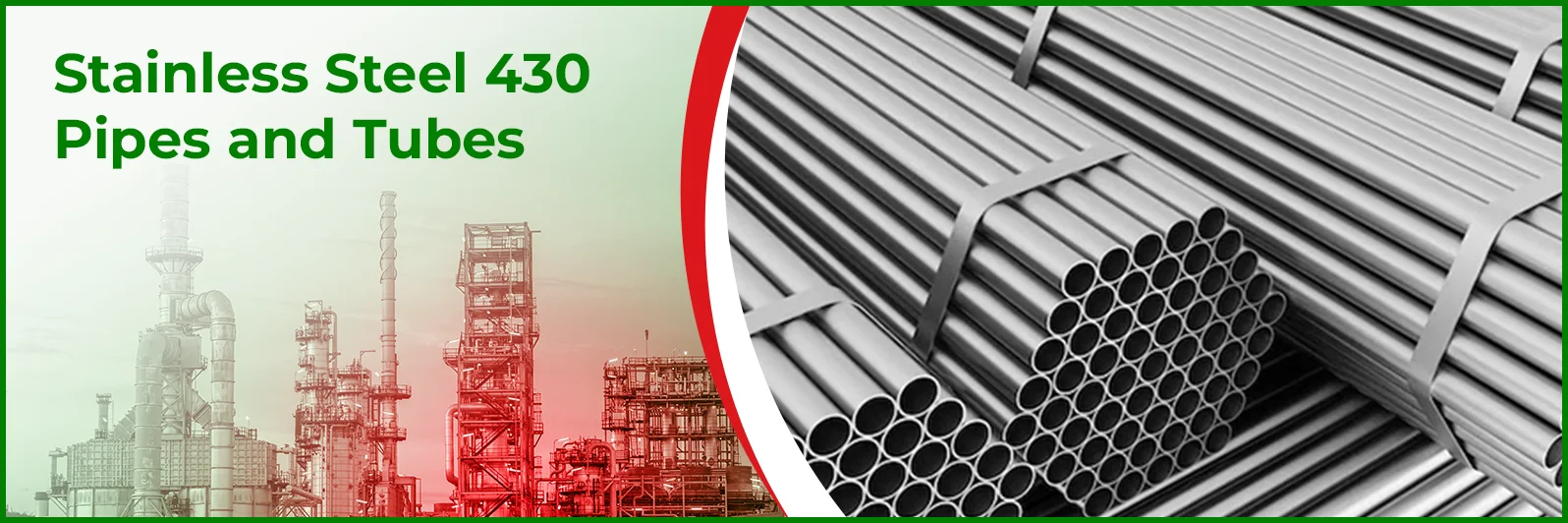
The attraction of 430 is what it leaves out. With no nickel, its price does not swing with the nickel surcharge, and its ferritic structure resists the chloride stress corrosion cracking that troubles austenitic grades in hot chloride service. What it gives up is pitting resistance and easy welding. The pipes and tubes are made of stainless steel 430 that has 16 to 18% chromium in a ferritic annealed basic structure. They suit decorative work, appliances, components and mild process duty at sites across Oman. Other grades are on the stainless steel pipes and tubes hub.
Where 430 Is Used
- Decorative and architectural tube, trim and handrails indoors
- Appliance and catering equipment components
- Mild process and water service at moderate temperature
- Heat exchanger shells and casings in non-chloride duty
- Hot water systems where chloride cracking rules out austenitic grades
For better corrosion resistance with stabilisation, 441 or 444 are the modern ferritic options; for general process service, 304/304L is more forgiving.
Ferritic Trade-Offs: What You Gain and Lose
Compared with 304 | 430 |
|---|---|
Nickel content | None, so the price is far steadier |
Chloride stress corrosion cracking | Ferritic structure is largely immune, which matters in hot chloride water |
Pitting resistance | Lower than 304 in most conditions |
Weldability | Lower; ferritic welds coarsen and lose toughness unless heat input is controlled, and 430 is not stabilised |
Formability | Good for simple forming, less ductile than austenitic grades |
Magnetic response | Magnetic, unlike annealed austenitic grades |
The magnetic response is worth noting on site: 430 sticks to a magnet, which people sometimes take as proof that material is not stainless. It is a ferritic stainless steel, and a PMI check settles the question properly.
430 Corrosion Behaviour
430 resists mild atmospheres, fresh water and many organic media, and it is largely immune to chloride stress corrosion cracking. It pits more readily than 304 in chloride-bearing conditions and is not suitable for marine exposure or acid service. It is not a sour service grade. State your service conditions in the RFQ; requirements are confirmed at quotation.
What Affects the Price of 430
- Alloy surcharges, which move with nickel, molybdenum and chromium markets
- Seamless or welded
- Size, schedule or wall, and length
- Surface finish and any polishing
- Testing, including corrosion testing and PMI
- Quantity and stock availability versus a mill order
- Certification (EN 10204 3.1 or 3.2) and third-party inspection
- Incoterm and destination port
Quotations are available in USD, OMR, AED, SAR, QAR, KWD and BHD, on EXW, FOB, CFR or CIF terms.
What to send for a quotation:
grade, standard, seamless or welded, NPS or OD, schedule or wall, length, quantity, finish, testing, certification, inspection, destination port and required date.
430 Certificates and Inspection
430 is supplied with EN 10204 3.1 certificates as standard, and EN 10204 3.2 certificates on request. Inspection by the buyer's nominated third-party agency can be arranged; state your requirement in the RFQ. Check the chemistry, the heat treatment condition, tensile results and any corrosion test report. PMI on receipt confirms the grade. See the MTC and EN 10204 certification guide.
Packing and Site Storage
Lead time is confirmed at quotation. Material ships with end caps and, where specified, protective wrapping. Keep it away from carbon steel racks, slings and grinding dust, since embedded iron rusts on the surface and can start pitting. On coastal Gulf sites, rinse salt deposits off before fabrication.
Fittings and Related Grades
- stainless steel fittings and flanges hub
- Stainless steel 441 pipes and tubes
- Stainless steel 444 pipes and tubes
430 is used in general fabrication and equipment across power generation and desalination and water treatment sites.
SS 430 FAQ
Is 430 magnetic?
Yes. It is a ferritic stainless steel and responds to a magnet, which does not mean it is not stainless.
Why choose 430 over 304?
Because it contains no nickel, so the price is steadier, and because it resists chloride stress corrosion cracking.
What are the drawbacks of 430?
Lower pitting resistance than 304 and less forgiving welding, since it is not stabilised.
Is 430 suitable for outdoor coastal use?
No. Salt spray will pit it. Use a higher-alloy ferritic grade or an austenitic grade with molybdenum.
What is the EN equivalent of 430?
1.4016 (X6Cr17).
What should I send for a quotation?
Send the grade, form, OD and wall, length, quantity, finish, certification, inspection and destination port.
Request a Quote for Stainless Steel 430 Pipes and Tubes
Send the OD, wall, finish and quantity, with the application described. Every enquiry is checked before the offer is prepared, so a chloride-exposed job is not filled with a grade that will pit.