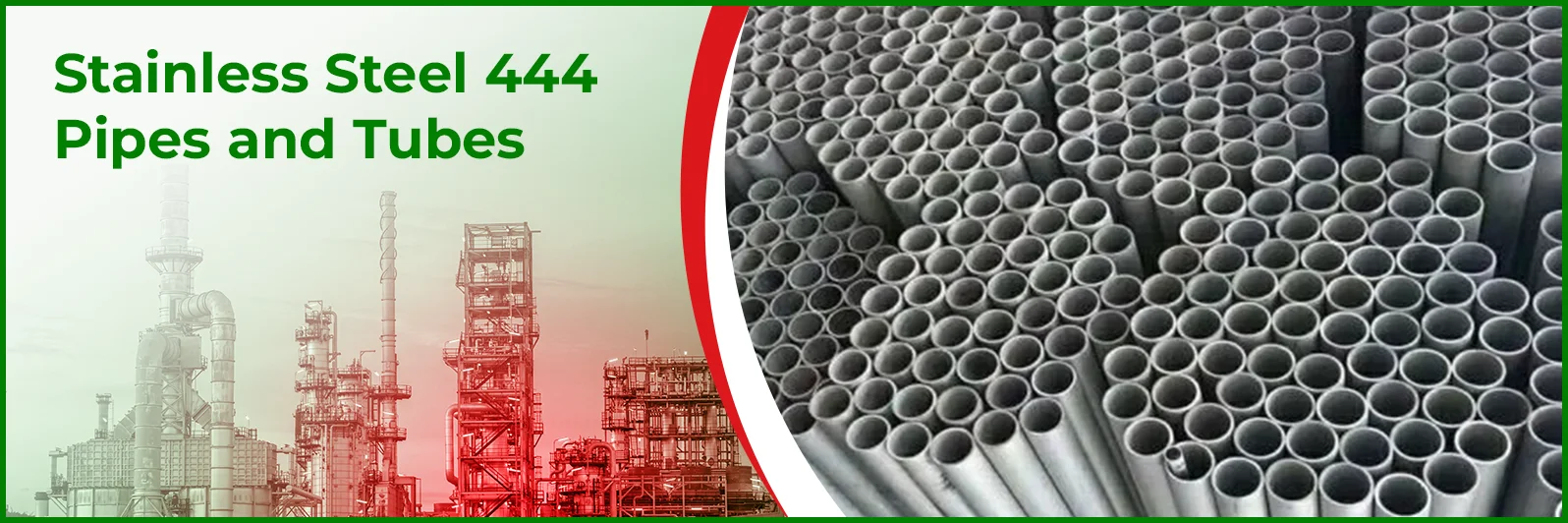
Hot chloride water is where austenitic stainless disappoints most often, because chloride stress corrosion cracking can split a 304 or 316 tube that shows almost no metal loss. A ferritic structure does not crack that way, and adding molybdenum gives it pitting resistance to match. That combination is what stainless steel 444 pipes and tubes offer, with about 18% chromium and 2% molybdenum in a stabilised ferritic structure. They appear in hot water systems, exchanger tubing and brine-adjacent service at plants across Oman. Other grades are on the stainless steel pipes and tubes hub.
Where 444 Is Used
- Hot water tanks, heaters and distribution tubing
- Heat exchanger and condenser tubes in chloride-bearing water
- Desalination plant auxiliary systems
- Solar thermal and process water circuits
- Applications where 316L would be at risk of chloride stress corrosion cracking
For higher chloride resistance in austenitic form, 904L or 254 SMO are alternatives, and duplex covers both strength and chlorides.
Why a Ferritic Grade Can Beat 316L in Hot Water
Mechanism | 316L (austenitic) | 444 (ferritic) |
|---|---|---|
Chloride stress corrosion cracking | Susceptible above roughly 50 °C in chloride service | Largely immune, because the structure is ferritic |
Pitting resistance | Good, from 2 to 3% molybdenum | Comparable, from 1.75 to 2.50% molybdenum |
Strength | 170 MPa minimum yield (316L) | 275 MPa minimum yield |
Nickel content | 10 to 14%, exposed to the nickel surcharge | Essentially nickel-free |
Weldability | Straightforward | Good for a ferritic grade, thanks to stabilisation, but heat input needs control |
The trade is toughness at low temperature and general fabrication ease, where austenitic grades remain easier. For hot chloride water in particular, though, 444 solves the exact failure mode that catches 316L out.
444 Corrosion Behaviour
444 combines pitting resistance close to 316L with the ferritic structure's resistance to chloride stress corrosion cracking, which makes it attractive for hot chloride water. It is less tough at low temperature than austenitic grades and is not usually chosen for cryogenic or heavy structural duty. It is not a general sour service grade; ferritic stainless steels have their own acceptance conditions under NACE MR0175 / ISO 15156-3. State your service conditions in the RFQ; requirements are confirmed at quotation.
Pricing 444 Pipe and Tube
- Raw material surcharges for the alloying elements in this grade
- Seamless or welded construction
- Diameter, wall thickness and cut lengths
- Required finish and cleanliness
- Testing, certification level and witness requirements
- Quantity and availability
- Incoterm and port of discharge
Quotations are available in USD, OMR, AED, SAR, QAR, KWD and BHD, on EXW, FOB, CFR or CIF terms.
What to send for a quotation:
grade, standard, seamless or welded, NPS or OD, schedule or wall, length, quantity, finish, testing, certification, inspection, destination port and required date.
Mill Certificates and Verification
444 is supplied with EN 10204 3.1 certificates as standard, and EN 10204 3.2 certificates on request. Inspection by the buyer's nominated third-party agency can be arranged; state your requirement in the RFQ. The certificate should record chemistry, heat treatment, tensile properties and any additional testing ordered. Positive material identification is worth specifying wherever several stainless grades share a fabrication shop. See the MTC and EN 10204 certification guide.
Storage and Contamination Control
Lead time is confirmed at quotation. Material is capped and, where specified, wrapped to protect the surface. Iron contamination is the main storage risk: carbon steel tools, slings and airborne grinding dust all leave particles that rust and can trigger pitting, so segregation on the Gulf laydown yard matters as much as the original grade choice.
Fittings and Related Grades
- stainless steel fittings and flanges hub
- Stainless steel 316/316L pipes and tubes
- Duplex and super duplex pipes and tubes
444 is used across desalination and water treatment and hot water systems in power generation plants.
SS 444 FAQ
What is 444 stainless steel?
A stabilised ferritic stainless steel with about 18% chromium and 2% molybdenum, offering pitting resistance close to 316L.
Why use 444 instead of 316L?
Because ferritic grades resist chloride stress corrosion cracking, which is the usual failure mode for 316L in hot chloride water.
Is 444 nickel-free?
Effectively, with nickel limited to 1.00% maximum, so it avoids the nickel surcharge.
Is 444 as strong as 316L?
Its minimum yield strength is higher, at 275 MPa against 170 MPa for 316L.
What is the EN equivalent of 444?
1.4521 (X2CrMoTi18-2).
What should I send for a quotation?
Send the grade, form, OD and wall, length, quantity, finish, testing, certification, inspection and destination port.
Request a Quote for Stainless Steel 444 Pipes and Tubes
Send the OD, wall, length and quantity, with the water chemistry and temperature if the line is in chloride service. Every enquiry is checked before the offer is prepared, so the grade is matched to the failure mode that actually threatens the system.