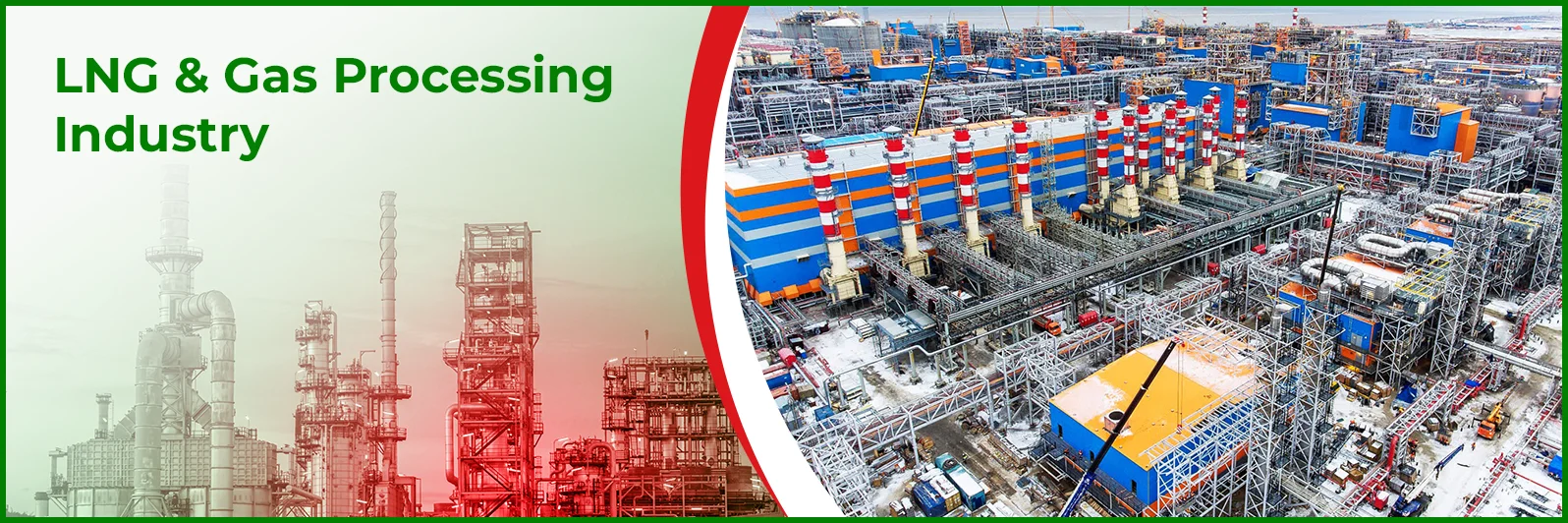
An LNG facility is three plants sharing a fence. Utilities run at ambient in ordinary carbon steel, the process train runs sub-zero and needs impact tested material, and the storage and loading end runs cryogenic where only a few materials work at all. Treating the site as one specification over-specifies the utilities and under-specifies the cold end. LNG and gas processing piping across Oman and the GCC is selected by the regime at each point. The product ranges sit under pipes and tubes and pipe fittings and flanges.
The Three Regimes
|
Regime |
Temperature |
Pipe |
Fittings and flanges |
Bolting |
|---|---|---|---|---|
|
Ambient utilities |
Above zero |
Carbon steel, A106 Grade B |
A193 B7 with A194 2H |
|
|
Sub-zero process |
To minus 46 degrees C |
A320 L7 with A194 Grade 4 or 7 |
||
|
Deeper cold |
To minus 101 degrees C |
A333 Grade 3, 3.5 nickel |
A420 WPL3 and A350 LF3 |
A320 L43 or as the specification requires |
|
Cryogenic |
To minus 196 degrees C |
A333 Grade 8, 9 percent nickel, or austenitic stainless |
A420 WPL8, A350 LF8, or austenitic |
A320 B8 class austenitic bolting |
Austenitic stainless is the other cryogenic answer and the simpler one in some respects, because it keeps its toughness all the way down without an impact test regime to manage. It costs more and expands more, and the expansion is what makes long cryogenic runs in stainless a design problem of their own.
Why the Cold Comes From Places You Do Not Expect
The regime at a point is not always obvious from the process flow diagram:
- Joule-Thomson cooling. Gas expanding across a valve or an orifice drops in temperature sharply, so a line downstream of a pressure letdown can run far colder than the line feeding it
- Blowdown and emergency depressurising. A line that runs warm in normal operation chills on release, and the material requirement comes from a condition the line sees rarely
- Autorefrigeration on loss of containment. A leak flashing to atmosphere chills the metal around it
- Start-up and upset conditions. The minimum design temperature often comes from an upset case rather than normal operation
All four produce the same procurement consequence: the impact test temperature on the order has to come from the design minimum including upsets, not from the normal operating temperature. Getting that wrong produces a line that is correct for every day it runs normally.
Low Temperature Is a Test Result, Not a Chemistry
Carbon steel does not lose strength as it gets colder. It loses toughness, and over a narrow band rather than gradually, so a steel that absorbs plenty of energy at ambient can fracture in a brittle manner a few tens of degrees lower. Where that transition sits depends on grain size, deoxidation practice and heat treatment, none of which a chemical analysis reports.
The practical consequences on an LNG project:
- A350 LF2 and ordinary A105 cannot be told apart by chemistry, and neither can A420 WPL6 and A234 WPB. Positive material identification will not separate them either, because PMI reads composition
- The Charpy report is the identification. Three specimens at the specified temperature, with the individual values and the average, not a pass statement
- Segregation on site is the only reliable control. Once low temperature and ambient grade fittings are mixed in a rack, inspection cannot undo it
Materials, Certification and Inspection
Every item is supplied with EN 10204 3.1 certificates as standard, and EN 10204 3.2 certificates on request. Inspection by the buyer's nominated third-party agency can be arranged; state your requirement in the RFQ. Where a project runs to an operator or EPC material specification, send it with the enquiry so the offer is made against that document rather than against the governing ASTM or API standard alone. Positive material identification is worth specifying wherever alloy grades pass through the same yard. See the MTC and EN 10204 certification guide.
Lead time is confirmed at quotation. Material is packed for sea freight and for storage in Gulf conditions, with end caps, bevel and face protection, and separation of alloy items from carbon steel handling equipment.
What Affects the Price on LNG and Gas Processing Industry Work
- Grade and alloy content, which carry market surcharges
- Size, wall or thickness, and quantity against mill minimums
- Seamless or welded, forged or plate fabricated
- Testing scope: impact, hardness, HIC, corrosion testing, NDT and PMI
- Certification level and third-party inspection
- Incoterm and destination port
Quotations are available in USD, OMR, AED, SAR, QAR, KWD and BHD, on EXW, FOB, CFR or CIF terms.
What to send for a quotation:
the line list or material take-off, with grade and standard, size, wall or schedule, pressure class and facing where it applies, quantity, service conditions, testing, certification, inspection, destination port and required date.
Related Industries and Products
- Oil and gas industry
- Marine and offshore industry
- Low temperature fittings and flanges
- ASTM A333 Grade 6 low temperature pipes
- ASTM A350 LF2 low temperature flanges
LNG and Gas Processing Piping FAQ
Why does one facility need three different specifications?
Ambient utilities, sub-zero process and cryogenic storage are three different temperature regimes. One specification across the site over-specifies the utilities and under-specifies the cold end.
Where does unexpected cold come from?
Joule-Thomson cooling across a valve, blowdown and emergency depressurising, autorefrigeration on a leak, and upset conditions. The impact test temperature must come from the design minimum including upsets.
Can PMI identify a low temperature grade?
No. A350 LF2 and A105 are close enough in chemistry that composition analysis will not separate them, and the same holds for A420 WPL6 against A234 WPB. The Charpy report is the identification.
Is A193 B7 bolting acceptable on a cold line?
No. B7 is not impact tested and is not a low temperature grade. ASTM A320 L7 is the usual stud specification, with L7M where sour service also applies.
Does an impact tested item meet NACE automatically?
No. The two requirements are independent, so a forging supplied impact tested is not supplied to NACE MR0175 unless that is also stated on the order.
What should I send for a quotation?
Send the line list with grade, size, class, quantity, the design minimum temperature including upsets, the sour requirement where it applies, testing scope, certification and destination port.
Request a Quote for LNG and Gas Processing Industry Projects
Send the line list with the design minimum temperature including upset cases, and say whether bolting is in scope. Joints quoted without a bolting specification are flagged, because studs are the component most often left at an ambient grade.