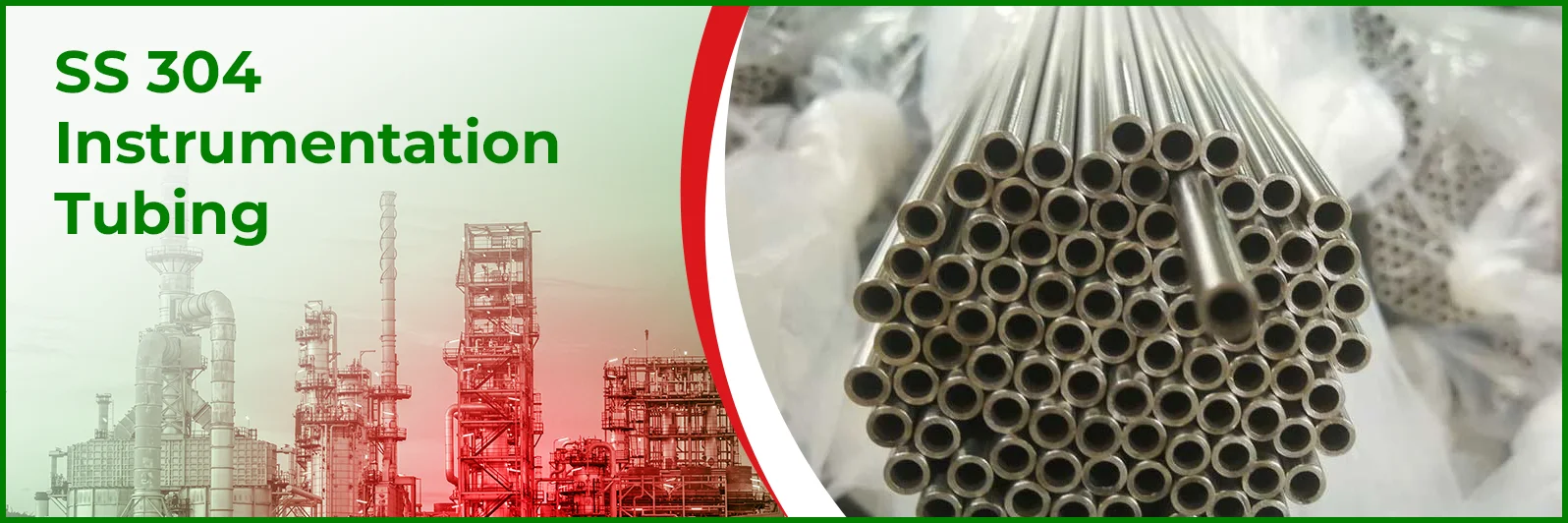
304 instrument tubing costs less than 316 and works just as well indoors, but the saving disappears the first time a coastal plant has to replace pitted tube runs on an outdoor rack. Where the tubing lives decides whether the grade is sensible. SS 304 instrumentation tubing is supplied fully annealed to ASTM A269, in fractional and metric sizes, with the same tolerance and surface requirements as 316. Only the corrosion resistance differs. It suits pneumatic and control lines in sheltered locations at plants across Oman. Related products are on the stainless steel instrumentation tubing hub.
Where 304 Instrumentation Tubing Suits
- Pneumatic supply and signal lines inside control rooms and panels
- Indoor utility and air lines
- Laboratory and workshop installations
- Non-critical sampling lines in dry, clean conditions
- Applications away from salt spray, chlorides and washdown
For outdoor, coastal or offshore installations, use SS 316 instrumentation tubing instead.
304 or 316 Tubing: A Location Decision
Location | Suitable grade | Reason |
|---|---|---|
Control room, panel interiors, indoor plant rooms | 304 | Dry, filtered air with no chloride exposure |
Outdoor racks at inland sites | 304 with care, or 316 | Dust and humidity, limited chlorides |
Coastal and offshore installations | 316 | Salt-laden air pits 304, particularly under clamps |
Washdown areas and chemical zones | 316 or higher | Chlorides and cleaning agents attack 304 |
Process impulse lines carrying chloride-bearing fluid | 316 or higher | Internal corrosion as well as external |
The cost difference between 304 and 316 tubing is real but small against the labour of replacing a corroded run on a live plant. Where the decision is marginal, most operators standardise on 316 so that stores hold one grade and no one has to judge each location.
Like all instrument tubing, 304 must be fully annealed, with close tolerances and a clean surface, so compression ferrules can bite and seal.
Where 304 Tubing Fails
304 tubing pits in chloride-bearing air, and instrument tubing is especially exposed: small diameter, often uninsulated, and frequently clamped in ways that create crevices where salt collects. In coastal Oman conditions that can mean visible pitting within a few seasons. It is not a sour service material; for H2S exposure, 316L within ISO 15156-3 limits or a higher alloy is required. State your service conditions in the RFQ; requirements are confirmed at quotation.
304 instrumentation tubing Price Factors
Each enquiry is quoted individually, since alloy surcharges move week to week. What changes the figure:
- Grade and alloy content
- Product form, size and wall
- Finish, cleaning and passivation
- Supplementary tests and PMI
- Order quantity against mill minimums
- Stock or mill order
- Certificate level and inspection scope
- Delivery terms and destination port
Quotations are available in USD, OMR, AED, SAR, QAR, KWD and BHD, on EXW, FOB, CFR or CIF terms.
What to send for a quotation:
grade, standard, seamless or welded, NPS or OD, schedule or wall, length, quantity, finish, testing, the installation location and fitting system, certification, inspection, destination port and required date.
Certification, PMI and Inspection
Material comes with EN 10204 3.1 certificates as standard, and EN 10204 3.2 certificates on request. Inspection by the buyer's nominated third-party agency can be arranged; state your requirement in the RFQ. For 304 instrumentation tubing, review the chemistry, annealing details and mechanical results, and specify PMI so each item is verified before it goes into the line. See the MTC and EN 10204 certification guide.
Handling 304 instrumentation tubing on Site
Lead time is confirmed at quotation. Pipe and tube arrive capped, and wrapped where the finish requires it. Store on timber or plastic, not on carbon steel, and use dedicated slings, brushes and grinding discs. Salt-laden coastal air leaves deposits on stored material, so a rinse before welding is worth the time.
Related Products
- Stainless steel instrumentation tubing hub
- SS 316 instrumentation tubing
- Stainless steel 304/304L pipes and tubes
304 instrument tubing is used indoors across power generation, refinery and petrochemical and general plant installations.
SS 304 Instrumentation Tubing FAQ
When is 304 instrument tubing a sensible choice?
Indoors, in control rooms, panels and dry plant areas with no chloride exposure.
Why not use 304 outdoors in Oman?
Salt-laden coastal air pits 304, particularly in crevices under clamps, and replacing tubing on a live plant costs far more than the grade saving.
Does 304 tubing also need to be fully annealed?
Yes. All compression fitting tubing must be soft enough for the ferrule to bite, commonly 80 HRB maximum.
Which standard applies?
ASTM A269, usually with supplementary hardness, tolerance and surface requirements.
Is 304 tubing suitable for sour service?
No. Sour service needs 316L within ISO 15156-3 limits or a higher alloy.
What should I send for a quotation?
Send the OD, wall, size system, length, quantity, fitting system, hardness and surface requirements, certification and destination port.
Request a Quote for SS 304 Instrumentation Tubing
Send the OD, wall, quantity and where the tubing will be installed. Every enquiry is checked before the offer is prepared, so an outdoor coastal run is not filled with a grade that will pit.