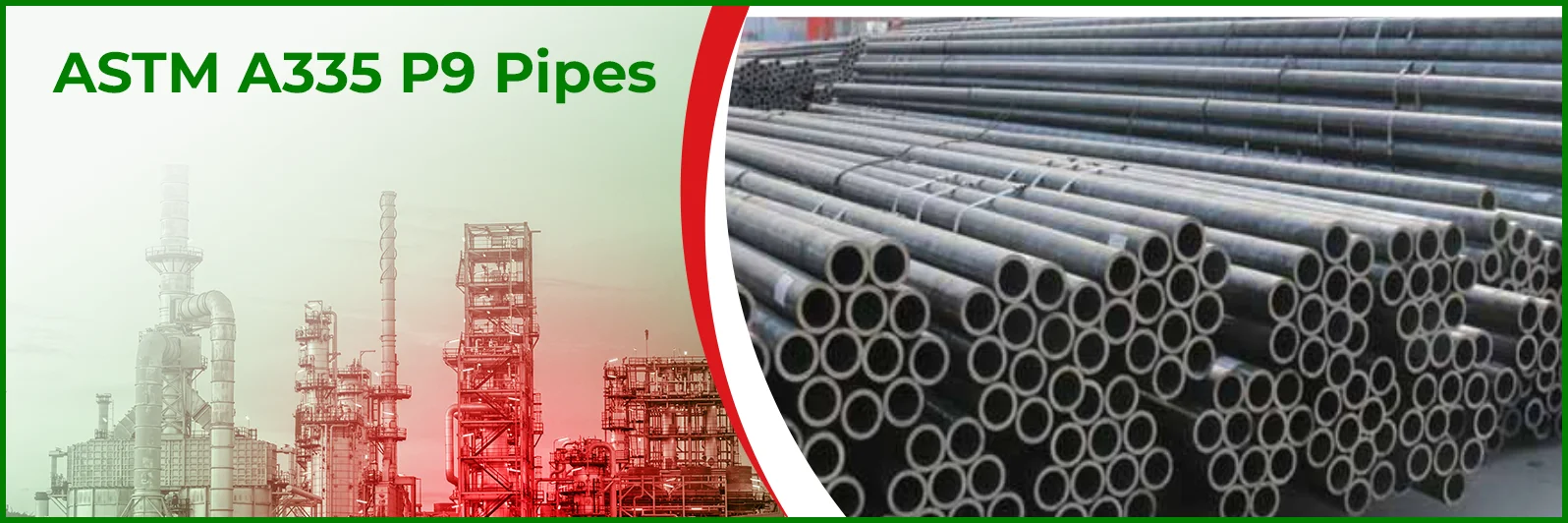
Sometimes P91 is depicted as P9 in sketches and confusion could carry on until a crack develops in a spool owing to creep. The reason for this lies in the fact that P91 contains niobium and vanadium which P9 doesn’t and at the same time, it has about two times more yield strength. Even though both steels are stamped in a similar way, their properties are different. The pipe made from the ASTM A335 P9 steel alloy contains 9% chromium and 1% molybdenum and its ability to resist high-temperature oxidation and sulfiding is more preferable to its creep resistance. The steel is utilized in combustion chamber, furnace and piping in the petrochemical industry in Oman for various processes while at the same time, liquid sulfur easily destroys carbon steel during the production cycle. Related grades sit on the alloy and chrome-moly pipes and tubes hub.
Where A335 P9 Pipe Is Used
- Refinery furnace and heater tubes, return bends and headers
- Crude and vacuum unit transfer lines in severe sulphidation service
- Hot hydrocarbon lines where P5 would corrode too quickly
- Hydrogen service where API RP 941 selection points to 9Cr
For less severe sulphidation, ASTM A335 P5 is more economical.
P9 vs P91: Similar Names, Different Steels
|
Property |
P9 |
P91 |
|---|---|---|
|
Chromium |
8.00 to 10.00% |
8.00 to 9.50% |
|
Molybdenum |
0.90 to 1.10% |
0.85 to 1.05% |
|
Vanadium, niobium, nitrogen |
Not specified |
Specified, forming strengthening precipitates |
|
Minimum tensile / yield |
415 / 205 MPa |
585 / 415 MPa |
|
ASME Section IX |
P-No. 5B |
P-No. 15E |
|
Main strength |
Sulphidation and oxidation resistance |
Creep strength at high steam temperatures |
P91's yield strength is roughly double that of P9, and its creep strength at high temperature is far higher. Designs based on P91 therefore use thinner walls, and a P9 spool installed by mistake can creep and fail. The welding procedures also differ, since they are different P-Numbers. PMI can confirm chromium but does not always distinguish P9 from P91, so heat numbers must be checked against certificates as well.
P9 in Sour and Hydrogen Service
Where P9 carries wet H2S, NACE MR0175 / ISO 15156-2 hardness limits apply to pipe and welds, and correct PWHT is essential. For hydrogen service, API RP 941 governs selection. State any sour or hydrogen requirements in the RFQ; they are confirmed at quotation.
What Drives the Price of P9 Pipe
- NPS and schedule, including heavy walls
- Quantity and mill rolling minimums for P9
- Stock availability versus a mill order
- Heat treatment records and supplementary tests: hardness, PMI, NDT
- Certification (EN 10204 3.1 or 3.2) and third-party inspection
- Incoterm and destination port
Quotations are available in USD, OMR, AED, SAR, QAR, KWD and BHD, on EXW, FOB, CFR or CIF terms.
What to send for a quotation:
grade, NPS, schedule or minimum wall, length, quantity, end finish, supplementary tests, certification, inspection, destination port and required date.
P9 Certificates and Inspection
P9 pipe is supplied with EN 10204 3.1 mill test certificates as standard, and EN 10204 3.2 certificates on request. Inspection by the buyer's nominated third-party agency can be arranged; state your requirement in the RFQ. Check that the certificate shows the heat treatment type and temperatures, full chemistry, including confirmation that no P91 alloying (V, Nb, N) is intended, tensile results and the hydrostatic or NDE record. PMI on receipt confirms the grade. See the MTC and EN 10204 certification guide.
Packing and Site Storage
Lead time is confirmed at quotation. P9 pipe ships with end caps or bevel protectors, grade stencilling along each length and colour coding where specified. On Gulf sites, store it off the ground in its own marked stack, away from carbon steel and other alloy grades, and keep ends capped against humidity and sand.
Fittings and Flanges for P9 Pipe
Complete the line in the same grade: ASTM A234 WP9 buttweld fittings and ASTM A182 F9 flanges and forged fittings.
- Alloy steel fittings and flanges hub
- ASTM A213 T9 tubes, the tube form of the same alloy
- Alloy steel seamless pipes and tubes
P9 is used mainly in refinery and petrochemical plants.
ASTM A335 P9 FAQ
Is P9 the same as P91?
No. P91 contains vanadium, niobium and nitrogen, giving much higher strength (415 MPa yield against 205 MPa for P9) and creep strength. They are not interchangeable.
Where is P9 used?
Mainly in refinery furnace tubes, heater piping and transfer lines in severe high-temperature sulphidation service.
What are the mechanical properties of P9?
Minimum tensile strength 415 MPa and minimum yield strength 205 MPa.
What is the EN equivalent of P9?
EN 10216-2 X11CrMo9-1 is the nearest equivalent.
Does P9 need post-weld heat treatment?
Under most codes, yes, with preheat before welding and hardness testing after PWHT.
What should I send for a P9 quotation?
Send the NPS, schedule, length, quantity, tests, certification, inspection, destination port and required date.
Request a Quote for ASTM A335 P9 Pipes
Send the NPS, schedule and quantity, with the furnace or piping specification attached. Every enquiry is checked against ASTM A335 before the offer is prepared, so a P9 versus P91 ambiguity on a drawing is resolved at the start.