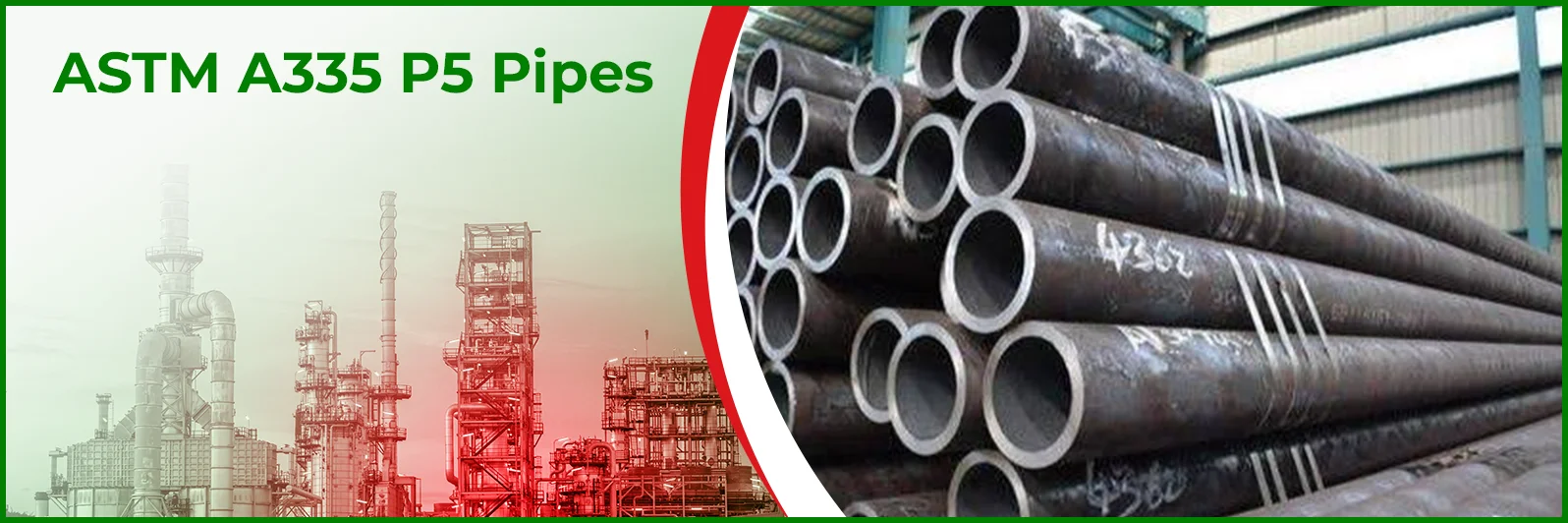
Sour crude and heavy oils containing sulphur erode metals used in carbon steel and lower chrome pipes through the sulphidation process. The 5% chromium in P5 ensures that this deterioration is slowed down effectively, making it a steeldock standard for heater or transfer lines. The effectiveness of chromium can further be confirmed by the fact that the stainless steel alloy possesses very high mechanical strength. The 5% chromium and 0.5% molybdenum combination allows ASTM A335 P5 to ensure a minimum yield tensile strength of 415 MPa and remain unaffected by the outlet-term furnace temperature. P5 is widely used in crude oil, vacuum, and coker-related processes in petroleum outside of Oman. Other grades are compared on the alloy and chrome-moly pipes and tubes hub.
Where A335 P5 Pipe Is Used
- Crude and vacuum unit heater outlet and transfer lines
- Delayed coker and visbreaker piping
- Hot high-sulphur hydrocarbon service between about 290 °C and the grade's upper limits
- Furnace crossovers and headers
- Hydrogen service where API RP 941 selection points to 5Cr
For more severe sulphidation, ASTM A335 P9 goes further. For steam service without sulphur, P11 or P22 are usually more economical.
Why Chromium Matters in Sulphidation Service
High-temperature sulphidation is controlled mainly by chromium content. As a general ranking of resistance in hot sulphur-bearing hydrocarbons:
|
Steel |
Nominal chromium |
Relative sulphidation resistance |
|---|---|---|
|
Carbon steel |
None |
Lowest |
|
P11 / P22 |
1¼% / 2¼% |
Modest improvement |
|
P5 |
5% |
Clear step up; the common refinery choice |
|
P9 |
9% |
Higher again |
|
12Cr and stainless |
12% and above |
Highest of these |
Actual corrosion rates depend on temperature, sulphur content and whether hydrogen is present, and refineries estimate them with published corrosion rate curves. The practical outcome is that P5 often lets a hot sulphur line run for a full turnaround cycle where carbon steel or P11 would need frequent replacement.
P5 variants: A335 also lists P5b (higher silicon) and P5c (with titanium), which are specified for particular services. Confirm which variant your specification calls for.
P5 in Sour and Hydrogen Service
In wet H2S service, NACE MR0175 / ISO 15156-2 limits hardness in pipe and welds, and P5 welds must be properly post-weld heat treated to meet it. For hydrogen service, API RP 941 governs selection. State any sour or hydrogen requirements in the RFQ; they are confirmed at quotation.
Pricing P5 Pipe
Each P5 enquiry is quoted individually, since alloy surcharges move with the market. What changes the figure:
- Pipe size, wall and total metres
- Mill minimum quantities, which matter for less common grades
- Whether the size is available now or has to be rolled
- Testing: PMI, hardness, NDT
- Certificate level (3.1 or 3.2) and inspection scope
- Delivery terms and destination port
Quotations are available in USD, OMR, AED, SAR, QAR, KWD and BHD, on EXW, FOB, CFR or CIF terms.
What to send for a quotation:
grade, NPS, schedule or minimum wall, length, quantity, end finish, supplementary tests, certification, inspection, destination port and required date.
Certification and Third-Party Inspection
P5 pipe comes with EN 10204 3.1 certificates as standard, and EN 10204 3.2 certificates on request. Inspection by the buyer's nominated third-party agency can be arranged; state your requirement in the RFQ. Review the chemistry, particularly chromium and molybdenum, heat treatment details, tensile results and hydrostatic or NDE record, and specify PMI so every length is verified. See the MTC and EN 10204 certification guide.
Packing, Marking and Yard Storage
Lead time is confirmed at quotation. Each length carries the grade stencil, with end caps or bevel protectors fitted. On site, a separate, clearly labelled stack for P5 prevents mix-ups with visually identical grades, and storage off the ground with caps on keeps sand and moisture out of the bore.
Fittings and Flanges for P5 Pipe
Complete the line in the same grade: ASTM A234 WP5 buttweld fittings and ASTM A182 F5 flanges and forged fittings.
- Alloy steel fittings and flanges hub
- ASTM A213 T5 tubes, the tube form of the same alloy
- Alloy steel seamless pipes and tubes
P5 is used mainly in refinery and petrochemical plants.
ASTM A335 P5 FAQ
What is A335 P5?
A seamless 5Cr-½Mo alloy steel pipe for high-temperature service, widely used in refineries for sulphur-bearing hydrocarbon lines.
Why is P5 used in refineries?
Its 5% chromium greatly improves resistance to high-temperature sulphidation compared with carbon steel and low-chrome grades.
What are the mechanical properties of P5?
Minimum tensile strength 415 MPa and minimum yield strength 205 MPa.
What is the difference between P5, P5b and P5c?
P5b has higher silicon and P5c contains titanium; both are variants for particular services. Confirm which your specification requires.
Do P5 welds need PWHT?
Under most codes, yes. P5 welds normally need preheat and post-weld heat treatment, followed by hardness testing.
What should I send for a P5 quotation?
Send the grade variant, NPS, schedule, length, quantity, tests, certification, inspection, destination port and required date.
Request a Quote for ASTM A335 P5 Pipes
Send the NPS, schedule and quantity, with the piping class attached. Every enquiry is checked against ASTM A335 before the offer is prepared, so the P5 variant and PMI requirements are confirmed at the start.