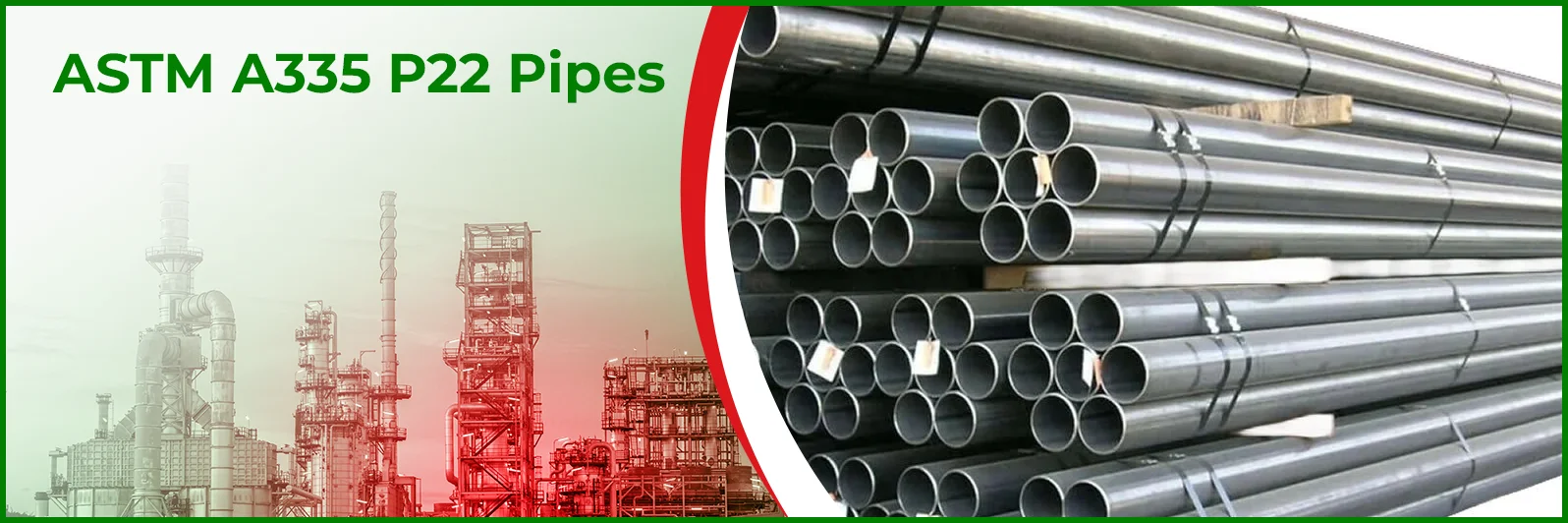
The hot hydrogen incurs erosive and corrosive attack to carbon steel internally in hydroprocessing plants, and the 2¼% Cr and 1% Mo of P22 makes it easier to work with in temperatures where its grades can be problematic. The abundance of the surplus is the reason behind the enormous popularity of P22 in hydrogen service. The P22 solution is an impeccable option through the entire process of ensuring high-quality seamless pipes for various applications around the globe. The complete range is on the alloy and chrome-moly pipes and tubes hub.
Where A335 P22 Pipe Is Used
- Hydrotreater, hydrocracker and reformer piping in hot hydrogen service
- Main steam and hot reheat lines in power plants
- High-temperature headers and superheater connections
- Hot process lines in petrochemical and fertilizer plants
For higher steam temperatures with thinner walls, P91 is the usual step up. For more moderate duty, ASTM A335 P11 is more economical.
Temper Embrittlement and the J-Factor
Heavy-wall 2¼Cr-1Mo equipment that runs for long periods in the temperature range where temper embrittlement occurs can lose toughness, mainly because of trace elements such as phosphorus and tin segregating to grain boundaries. Hydroprocessing purchasers often limit this through the J-factor:
J = (Si + Mn) × (P + Sn) × 10,000, with all elements in weight percent.
Worked example
|
Element |
Heat analysis (%) |
|---|---|
|
Silicon |
0.20 |
|
Manganese |
0.50 |
|
Phosphorus |
0.008 |
|
Tin |
0.005 |
J = (0.20 + 0.50) × (0.008 + 0.005) × 10,000 = 0.70 × 0.013 × 10,000 = 91.
A common purchaser limit is J ≤ 100, so this heat would pass; some specifications set other limits, and some add step-cooling tests. A335 itself does not set a J-factor, so any limit must be written into the order. If your piping is for hydrogen service, send the specification so the chemistry requirement can be confirmed with the mill.
P22 in Sour and Hydrogen Service
Under NACE MR0175 / ISO 15156-2, P22 pipe and welds must meet the applicable hardness limit, which depends on proper PWHT. For hot hydrogen, API RP 941 sets the operating limits for 2¼Cr-1Mo. State any sour or hydrogen requirements, including J-factor or step-cooling limits, in the RFQ; they are confirmed at quotation.
What Drives the Price of P22 Pipe
- NPS and schedule, including heavy walls
- Quantity and mill rolling minimums for P22
- Stock availability versus a mill order
- Heat treatment records and supplementary tests: hardness, PMI, NDT
- Hydrogen service chemistry limits such as J-factor or step-cooling tests
- Certification (EN 10204 3.1 or 3.2) and third-party inspection
- Incoterm and destination port
Quotations are available in USD, OMR, AED, SAR, QAR, KWD and BHD, on EXW, FOB, CFR or CIF terms.
What to send for a quotation:
grade, NPS, schedule or minimum wall, length, quantity, end finish, supplementary tests, J-factor or other hydrogen service limits, certification, inspection, destination port and required date.
P22 Certificates and Inspection
P22 pipe is supplied with EN 10204 3.1 mill test certificates as standard, and EN 10204 3.2 certificates on request. Inspection by the buyer's nominated third-party agency can be arranged; state your requirement in the RFQ. Check that the certificate shows the heat treatment type and temperatures, full chemistry, including tin if a J-factor limit applies, tensile results and the hydrostatic or NDE record. PMI on receipt confirms the grade. See the MTC and EN 10204 certification guide.
Packing and Site Storage
Lead time is confirmed at quotation. P22 pipe ships with end caps or bevel protectors, grade stencilling along each length and colour coding where specified. On Gulf sites, store it off the ground in its own marked stack, away from carbon steel and other alloy grades, and keep ends capped against humidity and sand.
Fittings and Flanges for P22 Pipe
Complete the line in the same grade: ASTM A234 WP22 buttweld fittings and ASTM A182 F22 flanges and forged fittings.
- Alloy steel fittings and flanges hub
- ASTM A213 T22 tubes, the tube form of the same alloy
- Alloy steel seamless pipes and tubes
P22 is used across refinery and petrochemical, power generation and fertilizer plants.
ASTM A335 P22 FAQ
What is A335 P22?
A seamless 2¼Cr-1Mo alloy steel pipe for high-temperature service, with 415 MPa minimum tensile and 205 MPa minimum yield.
Why is P22 used in hydrogen service?
Its chromium and molybdenum give far more resistance to high-temperature hydrogen attack than carbon steel or lower alloys, within the limits of API RP 941.
What is the J-factor?
A measure of susceptibility to temper embrittlement: J = (Si + Mn) × (P + Sn) × 10,000. Purchasers often set a maximum such as 100.
What is the EN equivalent of P22?
EN 10216-2 10CrMo9-10.
What is the difference between P22 and P91?
P91 has 9% chromium with vanadium and niobium, giving much higher creep strength and allowing thinner walls at high steam temperatures.
What should I send for a P22 quotation?
Send the NPS, schedule, length, quantity, any hydrogen service chemistry limits, tests, certification, inspection, destination port and required date.
Request a Quote for ASTM A335 P22 Pipes
Send the NPS, schedule and quantity, with your hydrogen or steam piping specification attached. Every enquiry is checked against ASTM A335 before the offer is prepared, so J-factor and heat treatment requirements are agreed with the mill at the start.