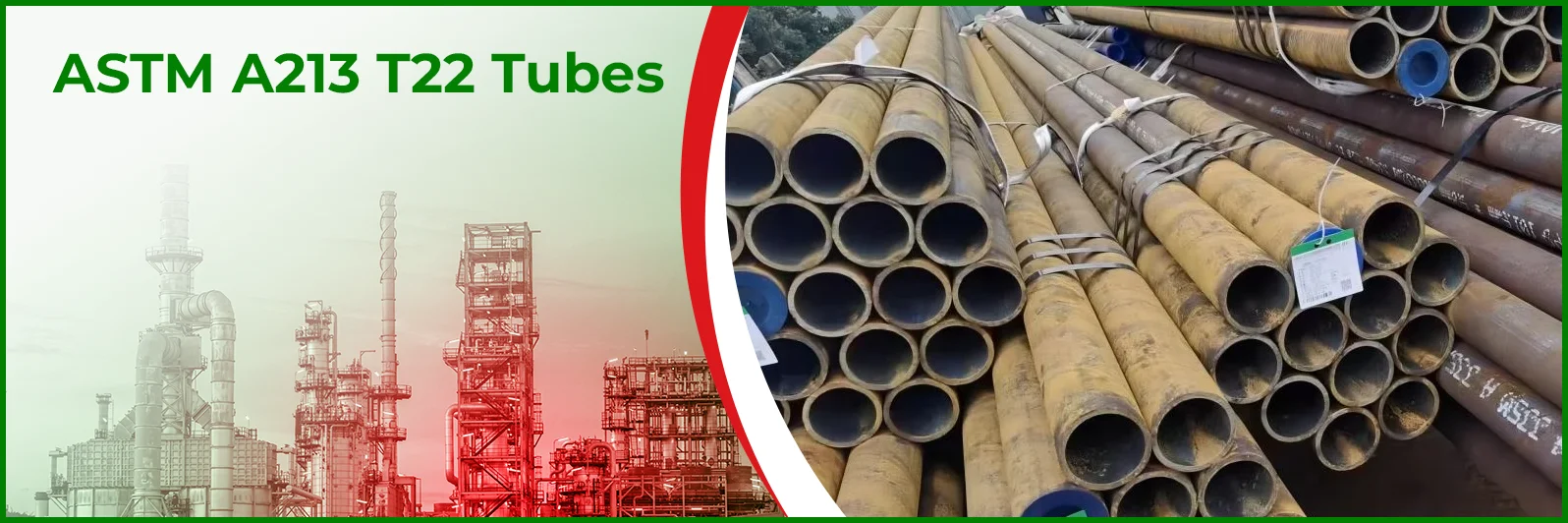
Where a superheater changes from T22 to an austenitic grade partway up the element, the dissimilar metal weld becomes the part that fails first, because the two steels expand at different rates and carbon migrates out of the ferritic side over years of service. The joint outlives nothing. With 2¼% chromium and 1% molybdenum, ASTM A213 T22 tubes hold 415 MPa minimum tensile strength and carry the hottest ferritic sections of a boiler. They are used in utility and HRSG boilers across Oman. Related grades are on the alloy and chrome-moly pipes and tubes hub.
Where A213 T22 Tubes Are Used
- Superheater and reheater elements in the hottest ferritic zones
- Water-wall tubes in high-heat-flux areas
- HRSG superheater bundles
- Process heater coils in hydrogen-bearing service
- Transition sections below austenitic tubing
For cooler sections, ASTM A213 T11 is more economical; above T22's range, T91 takes over. The pipe form is ASTM A335 P22.
Dissimilar Metal Welds Above a T22 Section
|
Issue at a ferritic-to-austenitic joint |
What happens |
Common mitigation |
|---|---|---|
|
Different thermal expansion |
The austenitic side expands more on every start and stop, cycling stress into the joint |
Place the joint in a cooler, lower-stress location |
|
Carbon migration |
Carbon moves from the T22 side into the higher-chromium weld metal, leaving a soft, weak band |
Use a nickel-based filler metal rather than an austenitic stainless filler |
|
Oxide notch |
An oxide notch can form at the interface and grow into a crack |
Inspect the joints at outages and record their locations |
|
Weld location records |
Failures often occur years later, when nobody remembers where the joints are |
Keep a drawing of every dissimilar metal weld |
This is why boiler makers position the transition carefully and why many owners specify nickel-based filler for these welds. When ordering replacement T22 elements, state whether the element includes a dissimilar joint so the correct consumables and procedures are planned.
T22 Tubes in Hydrogen and Sour Service
For hot hydrogen service, material selection follows API RP 941, where 2¼Cr-1Mo has substantially more margin than lower alloys. Where wet H2S is present, NACE MR0175 / ISO 15156-2 hardness limits apply to tube and welds. State any sour or hydrogen requirements in the RFQ; they are confirmed at quotation.
What Affects the Price of T22 Tubes
- OD, wall and cut length
- Hot finished or cold drawn
- Bending, end preparation and any special cleaning
- Quantity and mill minimums
- Stock availability versus a mill order
- PMI, hardness and supplementary NDT
- Certification (EN 10204 3.1 or 3.2) and third-party inspection
- Incoterm and destination port
Quotations are available in USD, OMR, AED, SAR, QAR, KWD and BHD, on EXW, FOB, CFR or CIF terms.
What to send for a quotation:
grade, OD, minimum wall, length, quantity, bending details, tests, whether the element includes a dissimilar metal weld, certification, inspection, destination port and required date.
Certificates, PMI and Inspection
T22 tubes are supplied with EN 10204 3.1 mill test certificates as standard, and EN 10204 3.2 certificates on request. Inspection by the buyer's nominated third-party agency can be arranged; state your requirement in the RFQ. The certificate should show chemistry, heat treatment, tensile and hardness results, flattening and flaring tests and the hydrostatic or electric test record. Because alloy tubes look identical to one another, PMI on receipt is worth specifying. See the MTC and EN 10204 certification guide.
Packing, Marking and Storage
Lead time is confirmed at quotation. T22 tubes are bundled or crated with end caps and rust-preventive coating, and each tube carries the grade marking. On Gulf sites, keep tubes under cover and in grade-marked stacks, since a misplaced alloy tube in a boiler panel is difficult to find once welded in.
Related Tubes and Pipe
- ASTM A213 T11 tubes and T91 tubes
- ASTM A335 P22 pipes, the pipe form
- Stainless steel pipes and tubes for the austenitic sections above
T22 tubes are used across power generation and refinery and petrochemical plants.
T22 Tube FAQ
What is A213 T22?
A seamless 2¼Cr-1Mo boiler, superheater and heat exchanger tube with 415 MPa minimum tensile, 205 MPa minimum yield and a 163 HBW hardness limit.
Why do dissimilar metal welds above T22 fail?
Differential thermal expansion cycles the joint, and carbon migrates from the T22 side into the weld. Nickel-based filler metal and careful joint placement reduce the risk.
What is the difference between T22 and T91?
T91 adds vanadium, niobium and nitrogen with 9% chromium, roughly doubling yield strength and allowing thinner tubes at higher temperature.
Does T22 need PWHT?
Welds normally need preheat and PWHT under the governing code, with hardness verification afterwards.
What is the pipe equivalent of T22?
ASTM A335 P22.
What should I send for a T22 quotation?
Send the OD, minimum wall, length, quantity, bending details, any dissimilar weld requirement, certification, inspection and destination port.
Request a Quote for ASTM A213 T22 Tubes
Send the OD, minimum wall, bend details and quantity, with the element drawing attached. Every enquiry is checked against ASTM A213 before the offer is prepared, so transition joints and PWHT requirements are covered before fabrication.