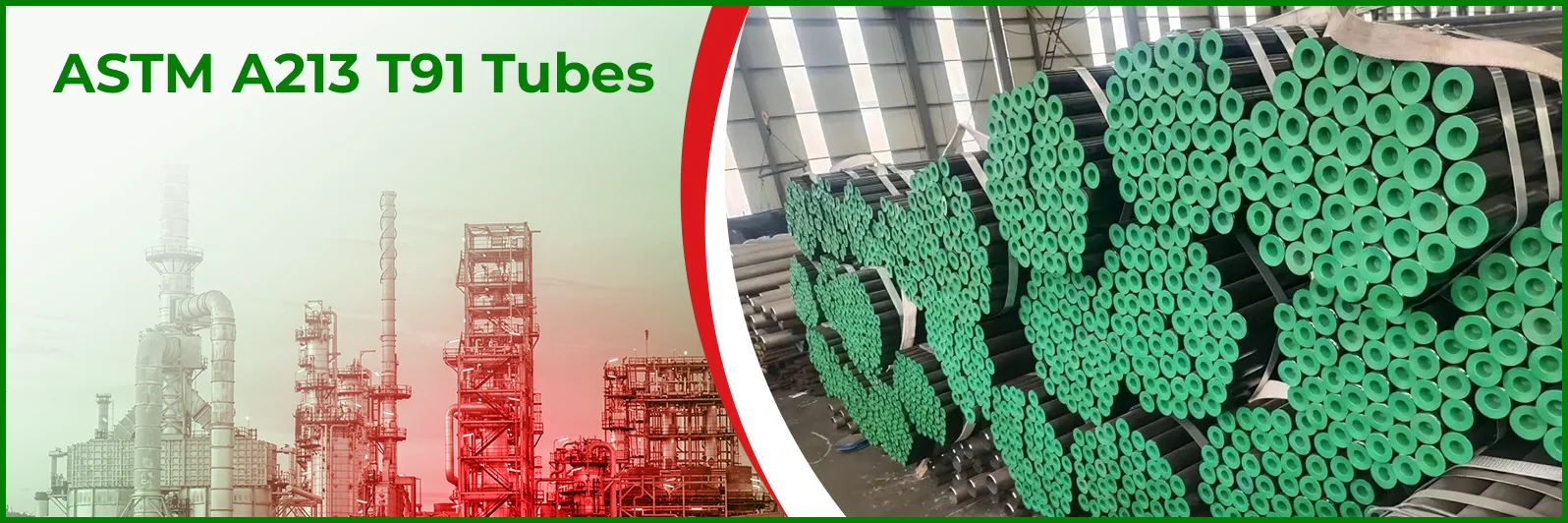
A T91 element that is cold bent hard and then welded into a header without the re-heat treatment the code calls for looks perfect on arrival and creeps years early in service. The damage is invisible on delivery. Vanadium, niobium and nitrogen alongside 9% chromium give T91 a 415 MPa minimum yield and a hardness band of 190 to 250 HBW that proves the tube was heat treated properly. It is used in high-temperature superheaters and reheaters across Oman. Related grades are on the alloy and chrome-moly pipes and tubes hub.
Where A213 T91 Tubes Are Used
- Superheater and reheater elements at high steam temperature
- HRSG high-pressure superheater bundles
- Outlet legs and header connection tubes
- Retrofits replacing thick T22 elements with thinner T91
- Process heater coils at high temperature
For cooler sections, ASTM A213 T22 is easier to fabricate, and T92 goes higher still. The pipe form is ASTM A335 P91.
Cold Bending, Heat Treatment and Hardness
T91 belongs to the creep strength enhanced ferritic family, and its strength comes from a tempered martensitic structure with fine precipitates. Fabrication can undo that.
Step |
What to watch |
|---|---|
Cold bending |
Design codes require re-heat treatment once cold strain passes set limits, because heavy cold work damages the creep structure |
Hot bending |
Bending above the tempering temperature usually calls for full re-normalising and tempering of the bent area |
Welding |
Preheat, interpass control and PWHT are all mandatory; a missed or short PWHT leaves hard, brittle weld metal |
Hardness on receipt |
The 190 to 250 HBW band is the quickest check; below 190 HBW usually means the tube is over-tempered |
Grade verification |
PMI must read vanadium and niobium, since chromium alone cannot separate T91 from T9 or T92 |
State bend radii and the fabrication route in the enquiry so the required heat treatment is agreed before the elements are made.
T91 Tubes and Service Environments
T91 is a high-temperature steam grade. Where H2S exposure is possible, NACE MR0175 / ISO 15156-2 hardness limits are difficult to reconcile with T91's own 190 HBW minimum, so selection should be reviewed with the operator. State any sour requirements in the RFQ; they are confirmed at quotation.
What Affects the Price of T91 Tubes
- OD, wall and cut length
- Hot finished or cold drawn
- Bending, end preparation and any special cleaning
- Quantity and mill minimums
- Stock availability versus a mill order
- PMI, hardness and supplementary NDT
- Hardness testing and PMI capable of reading vanadium and niobium
- Certification (EN 10204 3.1 or 3.2) and third-party inspection
- Incoterm and destination port
Quotations are available in USD, OMR, AED, SAR, QAR, KWD and BHD, on EXW, FOB, CFR or CIF terms.
What to send for a quotation: grade, OD, minimum wall, length, quantity, bending details, tests, bend radii and PMI scope, certification, inspection, destination port and required date.
Certificates, PMI and Inspection
T91 tubes are supplied with EN 10204 3.1 mill test certificates as standard, and EN 10204 3.2 certificates on request. Inspection by the buyer's nominated third-party agency can be arranged; state your requirement in the RFQ. The certificate should show chemistry, including vanadium, niobium and nitrogen, plus normalising and tempering temperatures, heat treatment, tensile and hardness results, flattening and flaring tests and the hydrostatic or electric test record. Because alloy tubes look identical to one another, PMI on receipt is worth specifying. See the MTC and EN 10204 certification guide.
Packing, Marking and Storage
Lead time is confirmed at quotation. T91 tubes are bundled or crated with end caps and rust-preventive coating, and each tube carries the grade marking. On Gulf sites, keep tubes under cover and in grade-marked stacks, since a misplaced alloy tube in a boiler panel is difficult to find once welded in.
Related Tubes and Pipe
- ASTM A213 T92 tubes and T22 tubes
- ASTM A335 P91 pipes, the pipe form
- Alloy steel seamless pipes and tubes
T91 tubes are used mainly in power generation plants and high-temperature refinery and petrochemical heaters.
T91 Tube FAQ
What is A213 T91?
A seamless 9Cr-1Mo-V-Nb boiler and superheater tube with 585 MPa minimum tensile, 415 MPa minimum yield and a hardness band of 190 to 250 HBW.
Why does T91 have a minimum hardness?
Hardness below 190 HBW usually means the tube was over-tempered and has lost creep strength, so the band proves correct heat treatment.
Does cold bending affect T91?
Yes. Design codes require re-heat treatment once cold strain exceeds set limits, because cold work damages the creep-resistant structure.
How is T91 distinguished from T9 and T92?
By vanadium, niobium and tungsten. Specify PMI that reads these elements, since all three are 9% chromium steels.
What is the pipe equivalent of T91?
ASTM A335 P91.
What should I send for a T91 quotation?
Send the OD, minimum wall, length, quantity, bend radii, hardness and PMI requirements, certification, inspection and destination port.
Request a Quote for ASTM A213 T91 Tubes
Send the OD, minimum wall, bend radii and quantity, with the element drawing attached. Every enquiry is checked against ASTM A213 before the offer is prepared, so heat treatment after bending is planned rather than discovered later.