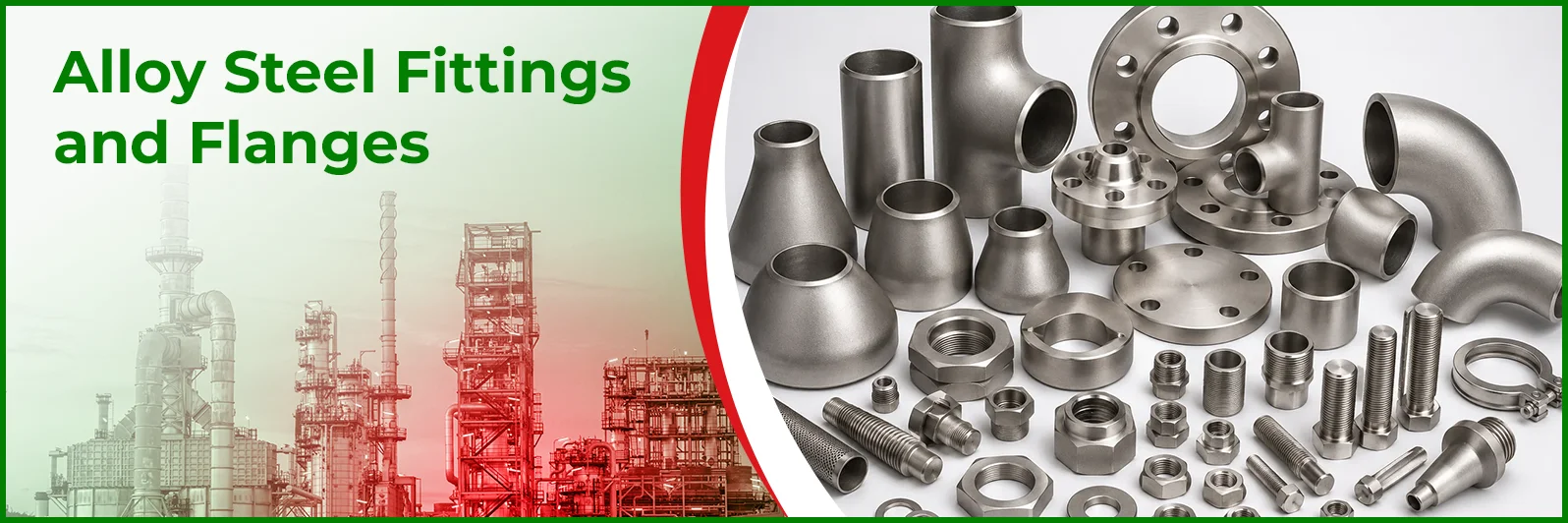
The chrome-moly pipe connection receives a single heat treatment after welding, and it is crucial that the temperatures and soak times of all parts of the connection are compatible with one another. If a WP11 fitting is used on a P22 line, then the process cycle for both grades is different, because one part can be properly tempered whilst the other can lose its creep resistance under the same conditions. Flanges and fittings made from alloy steels carry steam, hot oil, and hydrogen in refineries and power stations in Oman and GCC area. Grade matching is a heat treatment question before it is a strength one. The parent range is on the pipe fittings and flanges hub.
Grades and the Pipe They Match
| Fitting grade | Flange and forging grade | Matching pipe | Nominal composition | Typical duty |
|---|---|---|---|---|
A234 WP1 | A182 F1 | A335 P1 | Carbon-0.5Mo | Moderate temperature steam and process lines |
A234 WP5 | A182 F5 | A335 P5 | 5Cr-0.5Mo | Refinery heater and transfer lines, sulphidation service |
A234 WP9 | A182 F9 | A335 P9 | 9Cr-1Mo | Furnace and heater service at higher temperature |
A234 WP11 | A182 F11 | A335 P11 | 1.25Cr-0.5Mo | The workhorse first step above carbon steel |
A234 WP22 | A182 F22 | A335 P22 | 2.25Cr-1Mo | Hydroprocessing, hydrogen service, high temperature headers |
A234 WP91 | A182 F91 | A335 P91 | 9Cr-1Mo-V | Supercritical boilers and high temperature main steam |
Grade pages: ASTM A234 WP11 fittings, ASTM A234 WP22 buttweld fittings, ASTM A234 WP91 fittings, ASTM A182 F11 flanges and ASTM A182 F22 flanges. Matching pipe is on the alloy and chrome-moly pipes and tubes hub.
Post-Weld Heat Treatment as a Procurement Issue
PWHT relieves residual stress and tempers the hard martensite that forms in the heat affected zone when chrome-moly cools from welding. Three points turn it into a purchasing question rather than a site one.
The cycle belongs to the joint, not the component. Soak temperature and hold time are set by the grades being joined and by the thickest section in the joint. A heavy fitting raises the hold time for everything in that weld.
Grades have different tolerances. The lower chromium grades and the 9Cr-1Mo-V grades do not share a comfortable window. Mixing them across a weld forces a compromise, and on P91 an over-long or over-hot cycle removes creep strength that nothing on the outside of the pipe will reveal.
Condition on arrival matters. Fittings and flanges should arrive in the condition the standard requires, normally annealed, normalised and tempered, or quenched and tempered depending on grade and class. PWHT on site is an addition to that, not a substitute for it, so the certificate should record what the mill did.
Where a dissimilar joint is unavoidable, the welding engineer sets the procedure, but the material order has to reflect the decision rather than follow it.
Hydrogen Service and Temper Embrittlement
Two separate problems attach to the higher chromium grades in refinery service.
High temperature hydrogen attack. Hydrogen diffuses into the steel and reacts with carbides to form methane at grain boundaries. API RP 941 Nelson curves set the operating envelope by grade, and 2.25Cr-1Mo material has a usefully wider margin than the lower alloy grades. Note that the carbon-0.5Mo curve was withdrawn after service failures, so WP1 and F1 are now chosen for creep strength rather than hydrogen resistance.
Temper embrittlement. Long exposure in the range of roughly 340 to 575 degrees C raises the ductile-to-brittle transition temperature of 2.25Cr-1Mo material. The usual control is a chemistry restriction expressed through the J-factor, calculated as silicon plus manganese multiplied by phosphorus plus tin and by ten thousand, with a limit stated on the order. These are supplementary requirements rather than defaults, so they have to be specified. More detail is on the ASTM A182 F22 flanges page.
Pricing Alloy Steel Fittings and Flanges
- Raw material cost for the grade, including any alloy surcharge
- Item type, size, class and facing
- Wall or bore to match the connecting pipe
- Heat treatment condition and any supplementary tests
- Quantity and whether the item is a standard pattern or a special
- Certification (EN 10204 3.1 or 3.2) and inspection
- Incoterm and destination port
Quotations are available in USD, OMR, AED, SAR, QAR, KWD and BHD, on EXW, FOB, CFR or CIF terms.
What to send for a quotation: item type, material grade and standard, size, pressure class, facing, schedule or wall, quantity, testing, certification, inspection, destination port and required date.
Mill Certificates and Verification
EN 10204 3.1 certificates are supplied as standard, with EN 10204 3.2 certificates on request. Inspection by the buyer's nominated third-party agency can be arranged; state your requirement in the RFQ. The paperwork should record the governing standard and grade, heat number, heat treatment, the heat treatment condition and the class designation and tensile results, and should be traceable item by item to the stamping. Specify PMI where more than one grade passes through the same yard. See the MTC and EN 10204 certification guide.
Packing and Storage Before Installation
Lead time is confirmed at quotation. Machined faces, grooves and bevels are protected for sea freight and for storage in Gulf conditions: high ambient heat, humidity, blown sand and coastal chlorides all act on exposed metal. Keep stainless, duplex and nickel items physically separated from carbon steel handling equipment, because embedded iron particles rust and can start pitting on an otherwise sound surface.
Related Alloy Steel Products
- Alloy and chrome-moly pipes and tubes
- Carbon steel fittings and flanges
- Buttweld fittings
- Forged fittings
- Weld neck flanges
Supplied for power generation and refinery and petrochemical projects.
Alloy Steel Fittings and Flanges FAQ
Can a WP11 fitting be used on a P22 line?
Not without the welding engineer agreeing the procedure. The two grades do not share a comfortable post-weld heat treatment window, so a dissimilar joint forces a compromise cycle.
Why does the class designation matter on A234 and A182 grades?
The classes are different heat treatment conditions with different strengths. WP11 runs from 415 MPa minimum tensile in Class 1 to 520 MPa in Class 3, so a grade named without a class leaves the requirement open.
Is P91 just a higher chromium version of P9?
No. Both sit at around 9 percent chromium. The creep strength of P91 comes from its vanadium, niobium and nitrogen, so the two are not interchangeable.
Which grade is specified for hydrogen service?
2.25Cr-1Mo material, WP22 and F22, has a usefully wider margin on the API RP 941 Nelson curves. The carbon-0.5Mo curve was withdrawn after service failures.
What is temper embrittlement and how is it controlled?
Long exposure between roughly 340 and 575 degrees C raises the ductile-to-brittle transition of 2.25Cr-1Mo material. It is controlled by a chemistry restriction expressed through the J-factor, specified on the order.
What should I send for a quotation?
Send the item type, grade and class, NPS, schedule or wall, pressure class, facing, quantity, testing, certification, inspection and destination port.
Request a Quote for Alloy Steel Fittings and Flanges
Send the item type, grade, class and size with the pipe grade it is joining. Where fitting and pipe grades will not share one post-weld heat treatment cycle, that is raised before the offer rather than discovered by the welding engineer on site.