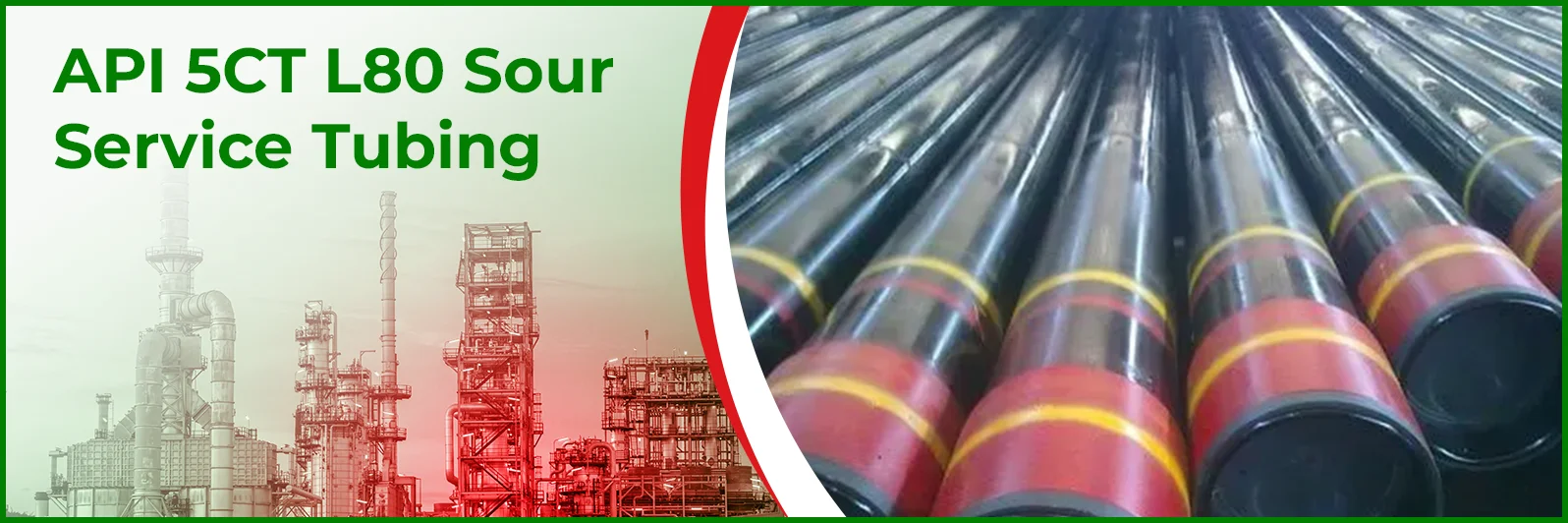
P110 goes into the deepest, highest-pressure casing strings, and the strength that earns it that place also makes it vulnerable to sulphide stress cracking wherever a sour well runs cool. Placement is everything. P110 casing to API 5CT is the Group 3 high-strength grade, quenched and tempered to a yield range of 758 to 965 MPa, and it delivers about 37% more burst capacity than L80 or N80 in the same size and weight. It is specified for deep gas wells, high-pressure production casing and liners across Oman, usually in the hotter lower sections of a well. Other grades are compared on the API 5CT casing and tubing hub.
Where P110 Casing Is Specified
- Production casing and liners in deep, high-pressure oil and gas wells
- Deep intermediate strings where burst and tension loads exceed what 80 ksi grades can carry at a practical weight
- High-pressure gas wells, often with premium gas-tight connections
- Fracturing and stimulation strings, where short-term pressures are very high
- Hot, deep sections of sour wells, above the minimum temperature at which ISO 15156-2 accepts P110
- P110 tubing in high-pressure sweet wells
For moderate depths, N80 casing and tubing is more economical. For sour sections at all temperatures, L80 sour service tubing and casing or the higher-strength Group 2 grades C90 and T95 are used instead.
P110 Mechanical Properties
|
Property |
P110 |
|---|---|
|
Group |
3 |
|
Yield strength (0.6% total elongation under load) |
758 to 965 MPa (110,000 to 140,000 psi) |
|
Minimum tensile strength |
862 MPa (125,000 psi) |
|
Hardness |
Not specified |
|
Heat treatment |
Quenched and tempered |
|
Charpy impact |
Required by API 5CT, with minimum energy depending on size and specimen orientation |
|
Colour band |
One white |
Note that P110's yield is measured at 0.6% total elongation under load, rather than the 0.5% used for J55, N80 and L80. That is a detail worth checking when comparing certificates across grades.
P110 in Sour Wells: Where It Can and Cannot Go
NACE MR0175 / ISO 15156-2 accepts P110 for sour service only above a minimum service temperature. At lower temperatures, its high strength makes sulphide stress cracking a serious risk. Because a well cools towards the surface, P110 in a sour well is normally confined to the deeper, hotter sections, with sour-resistant Group 2 grades such as L80 Type 1, C90 or T95 above it.
Temperature has to be judged over the whole life of the well, not just during production. Shut-in periods, injection and cool-down after stimulation can all bring P110 below its limit. Designers should read the exact threshold from the current ISO 15156-2 and check it against the lowest temperature each section will see.
Where high strength is needed in cooler sour sections, T95 or C90 are the usual answer, trading a little strength for sour acceptance at all temperatures. State your sour service and testing requirements in the RFQ; they are confirmed at quotation. See the NACE MR0175 sour service guide.
Standards for P110: API 5CT and ISO 11960
P110 is defined in API 5CT, with technically equivalent requirements in ISO 11960. There are no EN, DIN or JIS equivalents, since casing and tubing grades are specified to API and ISO worldwide. Casing design follows API TR 5C3.
Operators in the region often order P110 to PSL-2 or PSL-3, with extra Charpy testing, full-length NDT, special drift and specified premium connections. Send your specification with the enquiry and the offer will be prepared against it.
P110 Certificates and Inspection
P110 casing is supplied with EN 10204 3.1 mill test certificates as standard, and EN 10204 3.2 certificates on request. Inspection by the buyer's nominated third-party agency can be arranged; state your requirement in the RFQ. A P110 package should include chemistry, tensile results, Charpy impact results, heat treatment records, hydrostatic test, drift, full-length NDT and thread gauging, plus connection inspection records for premium threads. Check the single white colour band on delivery. See the MTC and EN 10204 certification guide.
P110 Casing Price Factors
P110 is quoted per enquiry, as steel prices and mill schedules move. The main drivers:
- Premium connections, often a large share of the total for gas wells
- Size, weight and range length
- PSL-2 or PSL-3 and supplementary testing
- Special drift or tighter tolerances
- Casing or tubing
- Quantity and mill minimums
- Stock availability versus a mill order
- Certification (3.1 or 3.2) and third-party inspection
- Incoterm, destination port and flat rack freight for Range 3
Quotations are available in USD, OMR, AED, SAR, QAR, KWD and BHD, on EXW, FOB, CFR or CIF terms.
What to send for a quotation:
grade, casing or tubing, OD, weight per foot, connection, range length, quantity, PSL, special drift, Charpy or other supplementary tests, sour temperature conditions if the well is sour, certification, inspection, destination port and required date.
Handling and Storing P110 on Gulf Yards
Lead time is confirmed at quotation.
P110 casing ships with thread protectors on every pin and box and storage compound on the threads. Premium connections need their own protectors kept on until make-up, since a damaged seal area can cause a gas leak at pressure. Rack casing off the ground with a slight slope, renew storage compound during long storage in humid coastal yards, and use UV-stable protectors if casing will sit in the sun. On a mixed yard, keep P110 clearly separated from L80, T95 and C90 of the same size, because running P110 in the wrong section of a sour well is a serious error.
Related OCTG and Surface Products
- API 5CT casing and tubing hub
- J55 and K55 casing for surface strings
- API 5L line pipe and RTJ ring type joint flanges for high-pressure surface connections
P110 is used across oil and gas and upstream oil and gas and sour service wells.
P110 Casing FAQ
What is the yield strength of P110 casing?
Yield must fall between 758 and 965 MPa (110,000 to 140,000 psi), measured at 0.6% total elongation under load. Minimum tensile strength is 862 MPa (125,000 psi).
How much stronger is P110 than L80?
Its minimum yield is 110,000 psi against 80,000 psi, so burst ratings are about 37% higher in the same size and weight. For 9-5/8 in 47 lb/ft casing, burst rises from 6,870 psi in L80 to 9,440 psi in P110.
Can P110 be used in sour wells?
Only above a minimum service temperature set in ISO 15156-2. It is normally confined to the deeper, hotter sections of a sour well, with L80, C90 or T95 in the cooler sections above.
Does P110 require Charpy testing?
Yes. API 5CT requires Charpy impact testing for P110, with the minimum energy depending on size and specimen orientation. Operators often add further toughness requirements.
What colour band identifies P110?
One white band on each length.
What should I send for a P110 quotation?
Send the OD, weight, connection, range length, quantity, PSL, special drift, supplementary tests, sour temperature conditions if relevant, certification, inspection, destination port and required date.
Request a Quote for P110 Casing
Send the size, weight, connection, range and quantity, with your well programme or operator specification attached if you have one. Every enquiry is checked against API 5CT before the offer is prepared, so gaps such as a premium connection without a named design, or P110 listed for a cool sour section, are raised at the start.