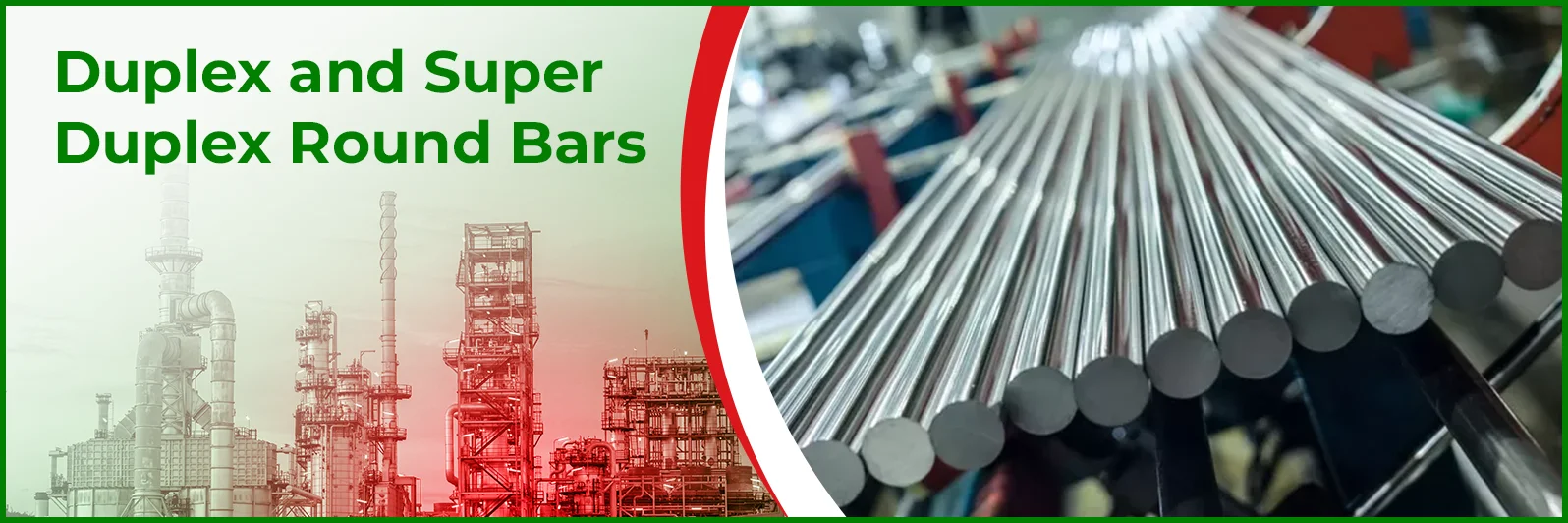
Compare a duplex bar against 316 on price per kilogram and the gap looks manageable. Put both on a lathe and the picture changes, because duplex cuts at a fraction of the rate, work hardens ahead of a dull tool and eats inserts, so a machined part can cost several times what the bar did. Anyone quoting a finished component from a bar price alone is quoting the smaller half of the number. Duplex and super duplex round bars serve valve, shaft and fastener work across Oman and the GCC. The range is on the round bars hub.
Machining Duplex Bar
|
Factor |
Effect |
|---|---|
|
High yield strength, 450 to 550 MPa |
Higher cutting forces and more power at the spindle than austenitic work |
|
Work hardening |
A tool that rubs rather than cuts leaves a harder surface for the next pass |
|
Two phase structure |
Ferrite and austenite machine differently, so the chip is less predictable |
|
Low thermal conductivity |
Heat stays in the cutting zone and goes into the tool |
|
Tool wear |
Insert life is markedly shorter than on 316, and tooling cost rises with it |
What the shop needs: rigid set-ups, sharp tooling changed on schedule rather than on failure, generous coolant delivered to the cutting zone, lower speeds with maintained feed, and no dwelling. The principle is the same one that governs nickel alloys: keep the tool cutting, because a tool that stops cutting creates a worse problem than the one it started with.
Two consequences for procurement:
- Quote finished parts on cycle time, not on material cost plus a percentage.
- Consider near net shape. Where a part is mostly machined away, forged or cast near net shape stock can be cheaper than bar despite a higher unit price.
Hardness, Sour Service and Why Both Matter on Bar
Bar goes into valve stems, shafts and fasteners, and those are exactly the components that sour service specifications set hardness limits on. Two things combine:
The machining case wants the material soft. Lower hardness cuts better and tools last longer.
The strength case wants it hard. A valve stem or a stud is sized on strength, and cold work raises both.
NACE MR0175 / ISO 15156 Part 3 sets environmental limits for duplex covering hydrogen sulphide partial pressure, chloride content and temperature, with hardness limits applied, and the limits differ between standard duplex and super duplex. Cold worked material is assessed separately from annealed. A bar supplied cold drawn or cold finished may sit outside the limit that the same grade annealed would meet, so the supply condition is part of the sour qualification rather than a detail.
Send the service envelope and the intended component with the enquiry.
Phase Balance on Large Diameter Bar
Duplex depends on a roughly equal split of ferrite and austenite, and on heavy bar the centre cools more slowly from the solution annealing temperature than the surface does. Slow cooling through roughly 600 to 950 degrees C precipitates sigma phase, which embrittles the metal and draws chromium and molybdenum from the surrounding material.
On large diameter bar, specify:
- Ferrite content measurement, with the test location stated
- Corrosion testing to ASTM G48 Method A where the service justifies it, on a sample representing the section
- Ultrasonic examination for centre soundness
A coupon taken from the surface of a heavy bar does not represent its core, which is where the slow cooling happened.
Where Duplex Bar Is Used
- Valve stems, shafts and trim in oil and gas and seawater service
- Fasteners and studs on marine and offshore installations
- Pump shafts and impellers in desalination and water treatment plants
- Forged flanges and fittings made from bar stock
- Machined components for chloride bearing process service
Matching products: duplex and super duplex plates, duplex and super duplex pipes and tubes and duplex fittings and flanges.
Duplex and Super Duplex Round Bars: Price Factors
Each enquiry is priced on its own, because grade, class and testing scope move the figure more than quantity does. What counts:
- Grade and the alloying elements it carries
- Size, pressure class, facing and bore
- Schedule or wall the item is made to
- Production route, forged or formed from pipe or plate
- Supplementary testing and inspection scope
- Order quantity and availability
- Certificate level and witness requirements
- Delivery terms and port of discharge
Quotations are available in USD, OMR, AED, SAR, QAR, KWD and BHD, on EXW, FOB, CFR or CIF terms.
What to send for a quotation:
item type, material grade and standard, size, pressure class, facing, schedule or wall, quantity, testing, certification, inspection, destination port and required date.
Certification, Traceability and PMI
Material comes with EN 10204 3.1 certificates as standard, and EN 10204 3.2 certificates on request. Inspection by the buyer's nominated third-party agency can be arranged; state your requirement in the RFQ. Check that the heat number on the certificate matches the marking on the item itself, and that the heat treatment condition is stated, the ferrite content and the solution annealing temperature and quench. Positive material identification confirms the grade before anything is welded in. See the MTC and EN 10204 certification guide.
Delivery and Handling
Lead time is confirmed at quotation. Fittings ship bundled or crated with bevel protection; flanges ship with face and ring groove protection, since a scored face leaks whatever the gasket. In coastal Oman, salt deposits build up on anything left in the open, so a rinse and a dry before fitting up is worth the time.
Related Products
- Round bars
- Stainless steel round bars
- Duplex and super duplex plates
- Duplex fittings and flanges
- Duplex and super duplex pipes and tubes
Duplex and Super Duplex Round Bars FAQ
Why does duplex cost more to machine than 316?
Higher yield strength raises cutting forces, the two phase structure makes the chip less predictable, low thermal conductivity puts heat into the tool, and the material work hardens if the tool stops cutting.
Should finished parts be quoted from the bar price?
No. On duplex the cycle time and tooling usually outweigh the material cost, so a finished part quoted from bar price plus a percentage understates it substantially.
Does the supply condition affect sour service qualification?
Yes. Cold work raises hardness, and NACE MR0175 assesses cold worked duplex separately from annealed, so a cold finished bar may sit outside a limit the annealed grade would meet.
Why does phase balance matter more on large diameter bar?
The core cools more slowly from solution annealing than the surface, and slow cooling through the sigma range embrittles the metal and depletes chromium and molybdenum locally.
Where should test coupons be taken on heavy bar?
From material representing the core, not the surface, because the slow cooling that causes the problem happened at the centre.
What should I send for a quotation?
Send the UNS number, diameter, condition, tolerance, length, quantity, the component it becomes, testing requirements, certification and destination port.
Request a Quote for Duplex and Super Duplex Round Bars
Send the UNS number rather than just 2205, with the diameter, condition and the component the bar becomes. Where the part is mostly machined away, the near net shape alternative is put on the offer alongside the bar price.