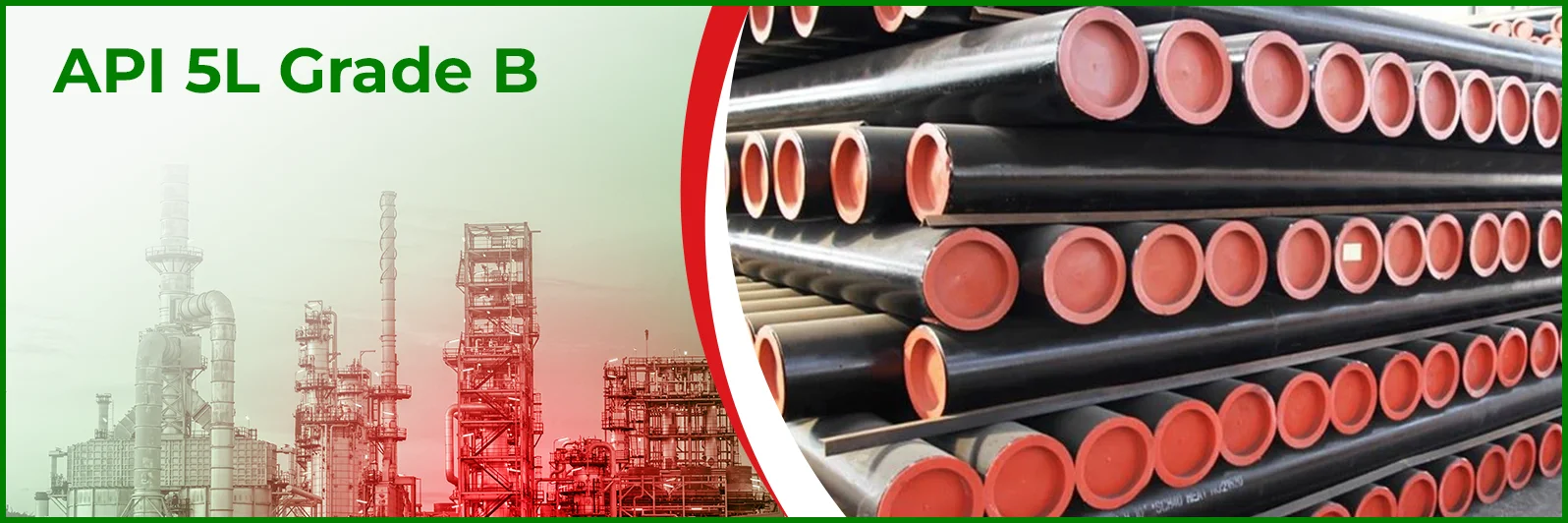
Plenty of material requisitions simply say "Grade B pipe", which leaves the supplier guessing between ASTM A106, ASTM A53 and API 5L, three standards with similar chemistry but different testing and marking rules. API 5L Grade B line pipe is the one written for pipelines: 245 MPa minimum yield, hydrostatically tested length by length, and available in PSL2 with impact testing and a capped yield strength for pipeline design codes. It is a natural fit for water injection, firewater and low-pressure gathering lines across Oman's oilfields. Easy to weld. Forgiving in the field. For higher-pressure lines, the API 5L line pipe hub covers the stronger X grades.
Where API 5L Grade B Pipe Is Used in the GCC
Grade B is chosen where pressure is modest and the line has to be simple to build and repair. In practice that covers:
- Upstream oil and gas: water injection and water supply lines, low-pressure gas gathering, fuel gas and flare headers
- Utilities in gas processing, refining and petrochemical plants: firewater rings, cooling water, plant air and nitrogen distribution
- Power and water: buried water transmission and plant utility lines
- Fertilizer and industrial sites: general utility and low-pressure process connections
Low strength is a real advantage here. Grade B tolerates a wide range of field welding procedures, bends and cold-works without drama, and is widely available in both seamless pipe and welded pipe. Where pressure or diameter starts to push the wall too thick, a designer moves up to API 5L X42 or API 5L X52.
API 5L Grade B Sizes and Wall Thickness (Metric and Imperial)
API 5L specifies wall thickness in millimetres, and the common walls below match ASME B36.10M schedules.
|
NPS |
DN |
OD (mm) |
OD (in) |
Sch 40 (mm) |
Sch 80 (mm) |
Sch 160 (mm) |
|---|---|---|---|---|---|---|
|
1/2 |
15 |
21.3 |
0.840 |
2.77 |
3.73 |
4.78 |
|
3/4 |
20 |
26.7 |
1.050 |
2.87 |
3.91 |
5.56 |
|
1 |
25 |
33.4 |
1.315 |
3.38 |
4.55 |
6.35 |
|
1-1/2 |
40 |
48.3 |
1.900 |
3.68 |
5.08 |
7.14 |
|
2 |
50 |
60.3 |
2.375 |
3.91 |
5.54 |
8.74 |
|
3 |
80 |
88.9 |
3.500 |
5.49 |
7.62 |
11.13 |
|
4 |
100 |
114.3 |
4.500 |
6.02 |
8.56 |
13.49 |
|
6 |
150 |
168.3 |
6.625 |
7.11 |
10.97 |
18.26 |
|
8 |
200 |
219.1 |
8.625 |
8.18 |
12.70 |
20.62 |
|
10 |
250 |
273.1 |
10.750 |
9.27 |
15.09 |
25.40 |
|
12 |
300 |
323.9 |
12.750 |
10.31 |
17.48 |
33.32 |
|
16 |
400 |
406.4 |
16.000 |
12.70 |
21.44 |
36.53 |
|
24 |
600 |
610.0 |
24.000 |
17.48 |
30.96 |
59.54 |
Larger diameters are produced as LSAW or spiral welded pipe. XS and XXS walls and intermediate thicknesses are listed in the pipe schedule, NPS and wall thickness guide, and weights are in the pipe weight chart.
- Manufacturing routes. Seamless pipe (SMLS) for smaller bores and heavier walls; HFW for small to medium diameters; LSAW and spiral SAW for large diameters. PSL2 welded pipe must be high-frequency welded.
- Ends. Plain end, bevelled at 30° (+5°, 0°) with a 1.6 mm root face (±0.8 mm) for field welding. Threaded and coupled ends are available in PSL1 for small bores.
- Tolerances. OD, wall, out-of-roundness and straightness follow API 5L.
- Lengths. API 5L orders line pipe in approximate length categories, most often around 6 m or 12 m. For containerised freight into Sohar, Duqm, Salalah, Jebel Ali or Dammam, 5.8 m and 11.8 m cut lengths fit 20 ft and 40 ft containers.
Sizes are supplied to specification. Send your OD, wall and length.
Is API 5L Grade B Suitable for Sour Service?
Yes, when it is ordered as PSL2 to Annex H, which gives the designations BNS, BQS or BMS. PSL1 Grade B is not intended for sour service.
NACE MR0175 / ISO 15156-2 sets the ground rules for carbon steel in H2S. Grade B's low strength works in its favour, because cracking resistance generally improves as strength and hardness fall. The standard still has to be met in full:
- Hardness no higher than 250 HV10 (22 HRC) in the pipe body, the weld and the heat-affected zone
- Tighter chemistry under Annex H, with sulphur held far below the normal PSL2 limit to reduce inclusion-driven cracking
- Hydrogen-induced cracking (HIC) testing to NACE TM0284, typically accepted at crack length ratio 15% max, crack thickness ratio 5% max and crack sensitivity ratio 2% max
- Sulphide stress cracking (SSC) testing to NACE TM0177 where the specification requires it
Water injection lines deserve a mention here. Produced water reinjected into a sour reservoir can carry H2S, so a line that looks like "utility service" on the P&ID may need sour-service pipe. It is worth checking the water source before settling on PSL1.
State your sour service and testing requirements in the RFQ. They are confirmed at quotation. The API 5L sour service line pipe page and the NACE MR0175 sour service guide cover this in more depth.
API 5L Grade B Pipe Price: What Affects It
Grade B prices move with steel markets, so they are quoted per enquiry rather than published. The factors that change the number:
- PSL and delivery condition. PSL2 costs more than PSL1, and Annex H more again.
- Seamless or welded. Seamless pipe usually costs more than HFW at the same size.
- Size and wall. Very small bores, heavy walls and large diameters narrow the choice of mills.
- Quantity. Small quantities of uncommon sizes cost more per tonne.
- Stock or mill order.
- Certification. EN 10204 3.1 or 3.2, and whether triple certification is needed.
- Third-party inspection and witness points.
- Sour service testing. HIC and SSC add time and cost.
- Coating or lining, if required.
- Incoterm and destination port.
Quotations are available in USD, OMR, AED, SAR, QAR, KWD and BHD, on EXW, FOB, CFR or CIF terms.
What to send for a Grade B quotation
Grade and PSL (with delivery condition for PSL2), any annex, seamless or welded, OD, wall, length, quantity, end finish, certification level, inspection requirement, destination port and required date.
Certificates, Marking and Inspection for Grade B Line Pipe
API 5L Grade B pipe is supplied with EN 10204 3.1 mill test certificates as standard, and EN 10204 3.2 certificates on request. Inspection by the buyer's nominated third-party agency can be arranged; state your requirement in the RFQ. Each length is marked with the standard, grade (with suffix for PSL2), PSL, size, heat number and, where the mill holds the licence, the API monogram. On triple-certified pipe, check that all three standards appear on both the stencil and the certificate. See the MTC and EN 10204 certification guide.
Packing, Delivery and Gulf Storage
Lead time is confirmed at quotation.
- Bevel protectors on both ends, or thread protectors and couplings on threaded pipe
- Varnish or temporary external coating on bare pipe where specified
- Small bores bundled in strapped hexagonal bundles; larger sizes loaded loose with spacers
- UV-stable end protectors for yard storage
Grade B is plain carbon steel, so external corrosion is the main storage risk. On coastal yards, humidity and airborne salt start surface rust within weeks, and blowing sand scores unprotected bevels. Keep pipe on sleepers off the ground, leave end protectors on until stringing, and plan external coating (for example 3LPE or FBE) and cathodic protection for buried lines. For water injection service, internal corrosion often decides pipe life more than pressure does, which is why internal lining or a corrosion allowance is commonly specified.
Matching Fittings and Flanges for Grade B Pipe
Grade B strength matches the standard carbon steel fittings and forged flanges used across plant and pipeline work:
- Carbon steel fittings and flanges hub
- Carbon steel buttweld fittings (ASTM A234 WPB elbows, tees and reducers)
- Carbon steel forged fittings for small-bore socket weld and threaded connections
- ASTM A105 carbon steel flanges
- Weld neck flanges and blind flanges
For sour Grade B lines, specify fittings and flanges with the same NACE MR0175 hardness and testing requirements as the pipe.
Industries Using API 5L Grade B
- Oil and gas: water injection, low-pressure gathering and fuel gas lines
- Upstream oil and gas and sour service: Annex H Grade B for sour water and gas
- Desalination and water treatment: buried water transmission and utility lines
API 5L Grade B FAQ
What is the difference between API 5L Grade B and ASTM A106 Grade B?
Both have a 415 MPa minimum tensile strength, but API 5L Grade B is a line pipe specification with a 245 MPa minimum yield, mandatory hydrotest of every length and a PSL2 option for pipelines. ASTM A106 Grade B is seamless pipe for high-temperature plant service with a 240 MPa minimum yield. Seamless pipe is often triple-certified to A106 B, A53 B and API 5L B PSL1.
Can API 5L Grade B be used for sour service under NACE MR0175?
Yes, when ordered as PSL2 to Annex H (BNS, BQS or BMS). That brings a 250 HV10 hardness limit, tighter chemistry and HIC testing to NACE TM0284. PSL1 Grade B is not intended for sour service.
Is API 5L Grade B available as seamless and ERW?
Yes. It is produced as seamless pipe, as HFW (high-frequency welded) pipe and, in large diameters, as LSAW or spiral welded pipe. PSL2 welded pipe must be high-frequency welded.
What is the yield strength of API 5L Grade B?
The minimum yield strength is 245 MPa (35,500 psi). In PSL2 it also has a maximum of 450 MPa (65,300 psi), and the tensile strength range is 415 to 760 MPa.
What lengths do you supply for container shipment?
Line pipe is ordered in approximate length categories, most often around 6 m or 12 m. For containerised freight, 5.8 m lengths fit a 20 ft container and 11.8 m lengths fit a 40 ft container.
What should I send for a Grade B quotation?
Send the PSL and delivery condition, any annex, seamless or welded, OD, wall, length, quantity, end finish, certification, inspection, destination port and required date.
Request a Quote for API 5L Grade B Line Pipe
Send the PSL, size, quantity and destination port, and attach your line list or operator specification if you have one. Every enquiry is checked against API 5L before the offer is prepared, so questions such as PSL1 versus PSL2, or whether a water line needs sour-service pipe, are raised at the start.