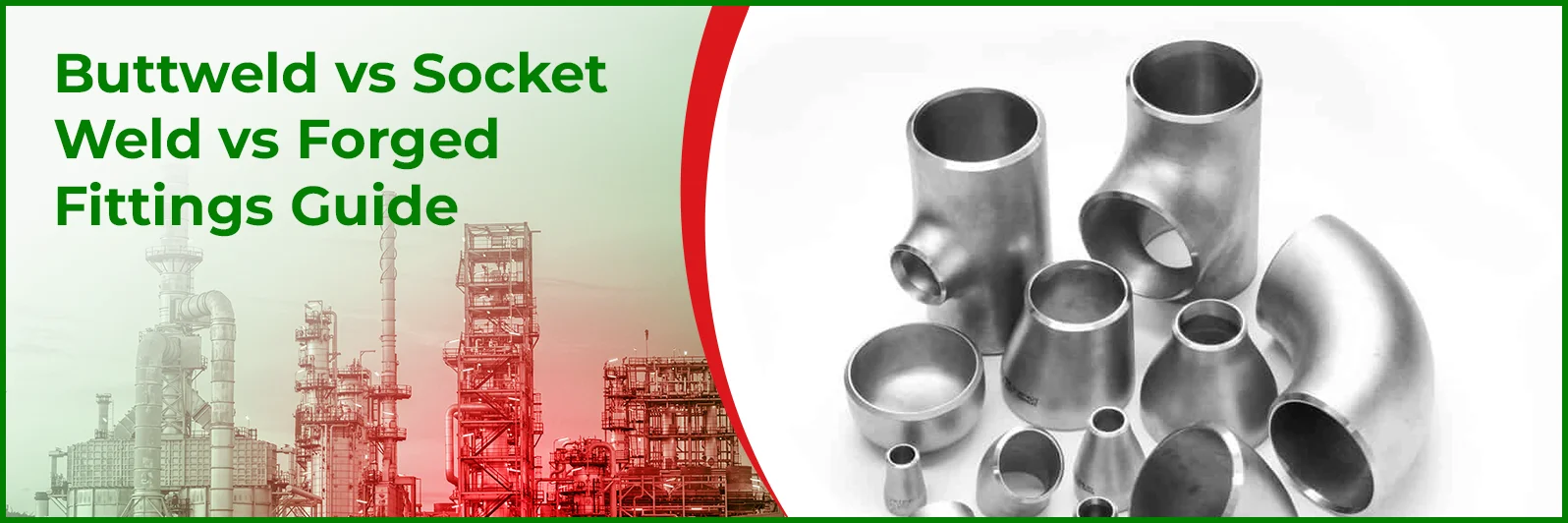
The choice between these three methods is not one based on the buyer's abortion. The arrangement is determined by means of size and by the capacity of the specifications: above a certain dimension, the process of butt welding will prevail over the socket welding and thread forge fittings which deal with pipes of a smaller diameter. What is worth understanding about buttweld vs socket weld vs forged fittings is the consequence of that division, because small bore joints are where systems leak, and the socket itself introduces a crevice that can undo the grade the line was specified in. Ranges are underbuttweld,socket weld andforged fittings.
The Three Types
|
Buttweld |
Socket weld |
Threaded |
|
|---|---|---|---|
|
Standard |
ASME B16.9 |
ASME B16.11 |
ASME B16.11 |
|
Ordered by |
Schedule, matching the pipe |
Class: 3000, 6000, 9000 |
Class: 2000, 3000, 6000 |
|
Joint |
Full penetration butt weld |
Fillet weld on the outside of the socket |
No weld |
|
Bore |
Matches the pipe, smooth |
A step at the socket shoulder |
A step at the thread |
|
Typical size range |
Larger bore, above the specification threshold |
Small bore |
Small bore, often where welding is restricted |
|
Examination |
Radiography practical |
Radiography not practical, surface methods instead |
Visual and pressure test |
The examination row is the one that quietly matters. A butt weld can be radiographed; a socket fillet weld cannot usefully be, so the quality assurance on small bore rests on procedure and workmanship rather than on volumetric examination. That is part of why small bore is where leaks appear.
Fitting Types: Buyer Questions
What decides between buttweld and socket weld?
Mostly size and what the piping specification permits, with buttweld above the specification's threshold and socket weld or threaded below it.
What is the 1.6 mm bottoming gap for?
The pipe is withdrawn about 1.6 mm from the bottom of the socket before welding so the weld does not absorb differential expansion. Without it the shrinkage stress goes into the fillet root.
Why is the socket crevice a problem?
It concentrates chlorides, so a line specified in 316L because the service is chloride bearing can fail at the socket while the straight pipe is untouched.
Can socket welds be radiographed?
Not usefully. Quality assurance on socket welds rests on procedure, workmanship and surface examination rather than volumetric examination.
Why are small forged fittings rated so highly?
Forging produces grain flow that follows the shape of the part rather than the interrupted grain of machined bar, so the forging class rather than the size states the pressure capability.
Do stainless forged fittings need anything carbon steel ones do not?
Yes, generally a solution anneal after forging, and duplex items need the ferrite and austenite balance verified because hot forming moves it.
Applying This to an Enquiry
Say whether the specification permits socket weld construction in the service, not just the size. On chloride bearing lines the crevice at the socket is the decision, and it is far cheaper to take it at enquiry than after the first leak.
Quotations are available in USD, OMR, AED, SAR, QAR, KWD and BHD, on EXW, FOB, CFR or CIF terms, with EN 10204 3.1 certificates as standard and 3.2 on request. Lead time is confirmed at quotation.